Sensory Diversity
  • Home
  • Blog
  • Neurodivergence
    • What is Autism?
    • What is ADHD?
    • What is Sensory Integration / Sensory Processing Disorder?
    • What is Misophonia?
    • What is Misokinesia?
  • Sensory Lifestyle
  • Sensory DIY
  • 0
qckxruozjrg
accommodationsAdvocacy

When Employers Ignore Misophonia Workplace Accommodations (Submitted Story)

by Sensory Diversity May 9, 2024
written by Sensory Diversity

Personal details have been omitted from this letter to protect the individuals involved. Misophonia International is publishing this letter as a way to inform the public and persons with misophonia on ways that workplace accommodations can impact the lives of sufferers of the condition.

I was hired on with [Unnamed Company] to work on a project in May, 2022 as an Automation and Controls Systems Engineer. I have been diagnosed with generalized anxiety and PTSD and have been under treatment for these conditions, as well as misophonia through an audiologist.

From May, 2022 to July, 2023, the majority of my work load was done from inside the Control Room. The Control Room is a very controlled environment and personnel have to follow very specific rules while working within the confines of the Con. In July of 2023 we completed the control room portion of this project.

For example, they have a strict rule of no gum chewing and the Con Operators must take turns eating their meals, it was a very spacious room where workers stations were all facing away from each other and the lighting was kept dim. It was overall a very low stimulating environment for personnel to work in. I make this point to say that this was for the most part a very safe place for me to work. I say, ‘for the most part’, because sometimes people would break the no gum chewing rule and it would aggravate my condition some, but a little stimulus is not as bad as what I was exposed to after we completed processing.

When we completed processing, my job definition changed a little bit. I was no longer required to be hands on with my system so consistently and as a result, I found myself mostly confined to my desk in the trailer. This is an open communal cubical situation where all the engineers work. Because of the nature of my neurological condition, it took me a couple months to realize that I could not work in this environment. I was continually being attacked by noises. When this happens, it causes me great pain and makes my brain function shut down and it effectively brain washes me, causing me to continually become more and more sensitive to stimuli and it is a very vicious spiral.

After months of research and searching for providers (I sought help from many doctors, ENTs, therapists, etc. who all turned me away, baffled at my condition) who knew of my very rare condition, I finally found an audiologist who was informed of my condition and I started seeing My Audiologist on December 15th, 2023. She diagnosed me with H93.293, which is an abnormal auditory perception of bilateral ears and fitted me out with sound generators, which I habituated to instantly. She also provided me with an accommodation letter that I could bring to my employer and get myself out of the dangerous environment that I was currently working in.

It just so happened that at that time, since my job details had changed due to the completion of processing, I was being transferred from the site to another location, so thought it would be an opportune time to present my accommodations letter.

My accommodations letter at the time stated I ought to be in an isolated workspace, away from other employees. I was given four different options, all cubical open communal stations, all next to other employees. I chose the desk that met my accommodations the best at the time, but it was Christmas and most people were on vacation at the time and I didn’t know that some people were going to be my neighbor in just a week or two after settling in.

I went back to My Audiologist and had her modify my accommodations to be more specific. In the beginning, she left it a bit vague because she wasn’t sure what my workplace looked like and wanted to leave it to my and my employer’s best judgment to work out. I had a lengthy conversation with her, explaining what my workplace was and we ironed out what my accommodations should be. We agreed that either having a door that shuts (having 4 enclosed walls with no other people) or the ability to work remotely and come on site as required would  be reasonable accommodations for my situation.

I then brought the updated accommodations back to my HR contact, and I submitted it via the correct avenues, emailing it to [Unnamed Individual] who I believe in in Employee Relations and then I waited. And waited.

I went to HR Rep several times over the following months asking about the status of my accommodations. Every time I spoke with her, it sounded promising and I wouldn’t have to wait much longer.

The entire time I was waiting, I was only getting sicker and sicker. I was beginning to suffer from major panic attacks.

On March 7th, 2023, I received an invitation from [Unnamed Individual], who is the Ethics Officer with Employee Relations to meet at 5pm to follow up on my accommodations. I was priorly engaged at that time and had to reschedule for the following Monday the 11th at 2pm. Nothing resulted from this conversation, either.

Then, the last time I spoke with her, on March 19th, 2024, I told her that since my accommodations haven’t been able to be worked out, me and my acting direct report, [Unnamed Supervisor], had worked out a deal where I work on site in the mornings and remotely in the afternoons. She told me he didn’t have the authority to give me the ability to do that. I told her that I need my accommodations and can only do what I can do. I asked if she was able to find an appropriate place for my desk location and she told me there was nowhere for me to be. So, I told her then, I will continue to do what I can do. She asked me how it was that I would like her to make my life perfect. I told her to read my doctors’ accommodations letter and said that it shouldn’t be this hard to help someone with a disability. I was crying by this point. I gave her a hug and told her that I was sorry for making a scene.

HR Rep proceeded to go directly to [Unnamed Supervisor]’s direct report and reported what I had told her and that he did not have the authority to make that call. I ended up taking PTO for the rest of the day as a mental health day, since I was not allowed to work remotely.

While I was at home trying to forget the stress, I received a text message from HR Rep;

“Hi [Author] this is HR Rep, you should have gotten an invite from [Unnamed Individual], we are following up on your ADA request. Would it be better for you to remain on PTO and take the call from home?” 4:32PM [HR Rep]

“I think maybe we should meet with my doctor too” 4:34PM [Author]

“She can explain my condition a lot better than I can” 4:35PM [Author]

“That would have to be an [Unnamed Individual] and [Unnamed Individual] call I can email then and let you know.” 4:37PM [HR Rep]

“Okay” 4:37 PM [Author]

“I have not heard back from the yet, I would plan on attending tomorrow and see what that meeting brings, if we need to schedule an appointment with your dr we can do that. I would think there would have to be some paperwork involved for your Doctor to speak to HR.” 5:46PM [HR Rep ]

“Whatever it takes” 5:48PM [Author]

The next morning, March 20th, 2024, I had My Audiologist on standby, ready to jump into the meeting, whenever they all decided to have it. Then I received an email from [Unnamed Individual] saying let’s go ahead and have the meeting without my doctor. Luckily for me, my mom is also an engineer who works on project. I had her come into the meeting with me to advocate for me, and it’s a good thing I did because they were posed to fire me.

HR Rep filed a complaint against me, the first and only one I’d had, and they said I was unprofessional and they didn’t know if they could allow me to continue working there. I had to pull the ADA card. My mom stated that I had mentioned in the past that I would be happy with a broom closet. I stated that it didn’t make sense to me, we have all these open offices, why couldn’t I just have one of those? [Unnamed Individual] turned the conversation on HR Rep, who gave the excuse that it was mostly filled with part timers. (I know I’ve seen at least one office that was completely void of personnel) At this point, I was crying and pleading, stating that please, I just want to be able to go to a restaurant again. (Being so inundated by noises in the work place as I was had made it so I was having to isolate myself more and more for the health of my brain.)

The end result was they sent me home that morning on short term disability on the promise that they would work out my accommodations situation, where I am now on May 9th, 2024. My short term disability still has not been approved. It has been over 7 weeks without pay and I do believe that [Unnamed Company] is fully responsible for this undue financial hardship.

They are denying my short term disability in terms of not enough medical information, even though all of my doctors have done their due diligence and after I signed their medical released, including a sweeping medical release. I’ve requested of all my doctors to go ahead and send my information in again, just this morning.

May 9, 2024 0 comments
0 FacebookTwitterPinterestEmail
204993
Coping

Marriage and Misophonia Isn’t Easy!

by Sensory Diversity May 5, 2024
written by Sensory Diversity

Kaitlyn’s Misophonia and Marriage Story

Printed with permission, this story will be part of the upcoming book “The Misophonia Marriage Handbook”

Luckily my husband has always been supportive of my misophonia. Even before we were married, he was an incredibly supportive, kind, and generous man. This does not mean he has always liked dealing with my misophonia, or that it hasn’t been hard to deal with—but, he has tried his best, nonetheless.

There have been endless couple’s negotiations through our 5+ years together. Many of them have included sleeping separately, not going to high-trigger places, and having shut doors when there will be triggers present. These are all things that seem simple on one hand yet impact our daily lives. Luckily chewing isn’t a main trigger—but we’ve relied on softer foods during some shows to cut the tension.

My problem with misophonia does not come from my husband at all, but from his mother and father who are painfully ignorant to the pain misophonia causes. According to his family I am selfish and keeping him away from them, yet they don’t invite us to events because my misophonia is “inconvenient”. I have tried over the years to share resources, to be very polite and kind asking for accommodations – and yet the end result has been the same, “this cranky mean witch has stolen our son away”. It has been incredibly painful to realize that no matter how hard I try this condition will never be recognized by some people. They are not the first family members who have treated me this way, but the others were on my own side and I was fine cutting them off.

The blessing here is that my husband does not care what they think and happily supports me through all of it, yet I am so sad that this important relationship in my life has been disintegrated because I am unable to attend social events in the way that people are “supposed to”. Sometimes I wonder if the misophonia is the problem at all – or if nobody would be good enough for her baby boy! I hope this reminder serves to highlight that romantic relationships can have for more complex outreaches than simply between your partner and you!

Want to be part of the project?

If you would like to submit an interview you can do so here:

https://sensorydiversity.com/submissions-wanted-interview-for-upcoming-book-on-misophonia-and-marriage/

If you would like to submit a free-hand story you can do so here:

https://sensorydiversity.com/misophonia-relationship-marriage-divorce-stories-for-book/


May 5, 2024 0 comments
0 FacebookTwitterPinterestEmail
2562361
Research

The Problem With Closed-Access Academic Journals

by Sensory Diversity April 28, 2024
written by Sensory Diversity

Today I spent much of the day searching for libraries that offer access to academic peer reviewed research articles, or even information on how a non-profit can purchase access to research journals that are not open-access. As I graduate from my most recent university program, I’m about to lose access to most of the scientific community. More recently there has been a push for Open-Access research journals that give the public and scientists alike free access to these journals, earning money through pay-for-publishing instead of passing this cost on the consumers/readers. Unfortunately, this model has not been adopted by every journal, despite large journals like Frontiers having this model. The Misophonia Research Journal, when we start it, will be completely Open-Access.

The problem with a lack of access to all academic resources is that the access to information is then tied to money. This also means that smaller organizations wanting to do research or independent clinicians submitting case studies have a harder time reading everything pertinent on the subject matter. Many important research studies are unread, even by well-meaning persons reporting on scientific topics such as journalists.

This issue is a larger part of the scientific problem of elitist science that is tied to monetary value more than the value of scientific research and knowledge for the sake of human good. I am not saying that these companies should not be able to make money; after-all, even non-profits must have enough funds to operate. That said, without an open-access policy for research, we are still in the dark-ages where finding important articles depends upon being accepted into the club, such as an organization with access, or paying to play and receiving access to these journals. That’s not even getting to the topic of journals which accept every paper submitted for the sake of the submission fee… that’s another story entirely.

As a society we must push for Open-Access research and push for governments to provide funding for scientific projects only if the research is publicly accessible.

April 28, 2024 0 comments
0 FacebookTwitterPinterestEmail
pexels minan1398 853168
Awareness

The Misophonia Advocacy, Research, and Clinical Alliance

by Sensory Diversity April 20, 2024
written by Sensory Diversity

For those of us who have misophonia and have dedicated much of our lives to advocacy, it has been a long and hard journey both professional and emotionally as we embark on this newly growing disorder. Over the past 10 years I have had the immeasurable honor of meeting so many respected researchers, clinicians, and scientists who are dedicated to ensuring that misophonia is not ignored and is researched. This warms my heart on so many levels. Although I just turned 30, I remember the ambitious 20-year-old girl who wanted to cure the disorder. I was so scared that misophonia was going to take up all my life and ruin what little chance I had at happiness. Of course, it wasn’t easy—but I was able to keep going and learn how to grow and live in this misophonic world. I even got a husband! With that said, much of this is why I attended a masters program in counselling psychology, and even more, why I wrote a book on coping with Misophonia called Misophonia Matters. Misophonia has been the fabric of my DNA from the first time I heard somebody whistle and the pain was so intense I felt weird, sad, and angry.

I think it’s important to point out that over the years there have become certain factions of advocates for misophonia. Getting along has not always been a priority, and while I do not think any of this is due to nefarious reasons, I believe we are all so hung up in our own misophonia and the absolute hell we endure, and sometimes we get caught up in our ideas and ideals on misophonia just the same. I think, though, that if us advocate, researchers, and clinicians worked together we could work for real change on misophonia. Misophonia—for those of us that live it is more than a behavioural problem or emotional intolerance—it rocks the very foundation of our lives causing severe neurophysiological pain. With that said, even if you believe misophonia is purely emotional or behavioural, that pain and what to do with it still remains.

I have fought, argued, and felt like I was at war with members of the misophonia advocacy and research community for over ten years. While I do admit some of this is my fault—I do believe others have had their own parts to play in disjointed advocacy and a race to own the disorder in the eyes of history. It is my proposal that instead of being against one another, we form “The Misophonia Alliance”. This would merely be a group of advocates, researchers, and clinicians sharing resources and pooling together our audiences to ensure that all of our information is getting to the world. I also offer the use of The International Misophonia Research Journal to all other advocates and nonprofits and of course researchers as a beacon of hope for the future—we look forward to having your work presented.

We are not at war with one another. Whether one of our books sells or the next, that is unimportant. What matters is that we are constantly striving to learn more and help those of us who suffer from the condition—the way we cope is less important than a legion banded together to tell the world that enough is enough. There are too many sounds, too many lights, and too much stimuli!

I invite ALL OWNERS OF MISOPHONIA WEBSITES, BLOGS, NON-PROFITS, and RESEARCH CENTERS to become members of The Misophonia Alliance. We will put a page live with links to all resources, and hope that each member does the same. Research helps us all. Awareness helps us all. Coping with misophonia is not a monopoly, it is a miracle!

If you would like to join this initiative—even if you weren’t on the best terms with me in the past, I invite you to, and actually hope and plead that you will.

The alliance will have the following goals:

  • Meeting together to discuss what each part of their community is most interested in
  • Sharing resources if possible
  • Have multi-website run polls to conduct polls that show the community’s feelings regardless of where they interact from
  • Provide a space where individual groups and interests can come together to convene

If you are interested in this project, you can add your website, research program, or business to the alliance now:

https://misophoniafoundation.com/the-misophonia-advocacy-research-and-clinical-alliance/

April 20, 2024 0 comments
0 FacebookTwitterPinterestEmail
joseph ledoux.jpg.optimal
AwarenessBook ReviewsResearch

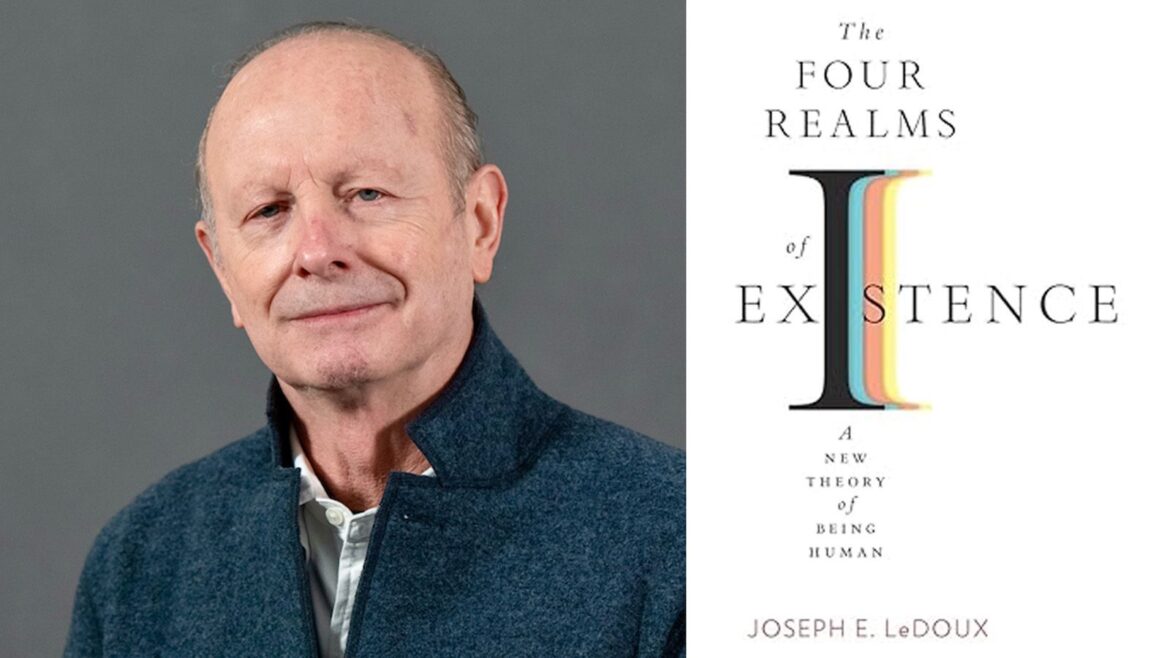
BOOK REVIEW: The Four Realms of Existence: A New Theory of Being Human

by Sensory Diversity April 6, 2024
written by Sensory Diversity

The Four Realms of Existence: A New Theory of Being Human by Dr. Joseph E. LeDoux

The Four Realms of Existence is offers a commentary on who we are, and more importantly, what that who and self is. These questions which many think are solved—we learn from LeDoux, are actually ideas of what the self is rather than a scientific concept. LeDoux does not shy away from discussing the evolution of Western ideas on these concepts of self—particularly that of philosophers reaching back to Ancient Greece, all the way to our modern theoretical concepts.

This struggle of humans to learn what and why we are is a question as old as humanity itself. In this book, LeDoux reflects on his long career in neuroscience, but from a purely humanistic view that is incredibly humble considering LeDoux’s incredible accomplishments in science within the past two centuries.

The Four Realms of Existence lays out these four realms in a way that is easy to understand whether you are an expert in neuroscience, or a layperson interested in discovering what our self is. LeDoux describes these realms as biological, neurobiological, cognitive, and conscious.

LeDoux lays out his concepts with delicate ease and provides both historical and scientific considerations of the theory of self. To say I recommend this book is putting it far too mildly—if you have any interest in neuroscience, cognitive science, or even just who you are, you should read this book!


Buy here: https://amzn.to/4ankdHT

April 6, 2024 0 comments
1 FacebookTwitterPinterestEmail
yuusajks3u4
Coping

CBT is a Valid Modality for Helping Persons With Misophonia Cope

by Sensory Diversity March 26, 2024
written by Sensory Diversity

Recently it was pointed out to me by a professional that I respect that my rhetoric on CBT is that of… well… an esteemed hater. I think it’s fair to point out that as a person I have been very hard on CBT when it comes to misophonia, perhaps zealously. This caused me to pause and reflect, even ever so slightly… on the message that I’ve been putting out into the world. Now, I will tell you that I am still cautious when it comes to CBT and its use for misophonia, but this mainly applies to exposure therapy.

CBT as a skill, is something that is incredibly useful for helping with the emotional and cognitive effects of misophonia that surround it—this can include social relationships, ideas of self and others, and the distress that follows living a life with misophonia. For that reason, however, I consider CBT to be a coping skill and not a “treatment” in the sense that you will still have misophonia even if you do vigorous CBT. In a way, CBT is almost like a mental health maintenance plan that can help you stay on track and not get lost in the throes of misophonia rage.

In-fact, I use CBT for myself and my clients with misophonia regularly. I believe that CBT has a place within the counselling room, and I also believe that it can be used alongside sensory regulation approaches, mindfulness, and other schools of thought like narrative based therapy. I take a “choose your own adventure” approach to coping with misophonia, however, and I caution practitioners not to stick to an intervention that the client has not responded well to. We’re all different! Below are some of the types of CBT that I find to be very useful for persons with misophonia.

    • SMART goals. SMART goals are specific, measurable, achievable, realistic, and time-limited.
    • Guided discovery and questioning. By questioning the assumptions you have about yourself or your current situation, your therapist can help you learn to challenge these thoughts and consider different viewpoints.
    • Journaling. You might be asked to jot down negative beliefs that come up during the week and the positive ones you can replace them with.
    • Self-talk. Your therapist may ask what you tell yourself about a certain situation or experience and challenge you to replace negative or critical self-talk with compassionate, constructive self-talk.
    • Cognitive restructuring. This involves looking at any cognitive distortions affecting your thoughts — such as black-and-white thinking, jumping to conclusions, or catastrophizing — and beginning to unravel them.
    • Source: https://www.healthline.com/health/cognitive-behavioral-therapy#techniques

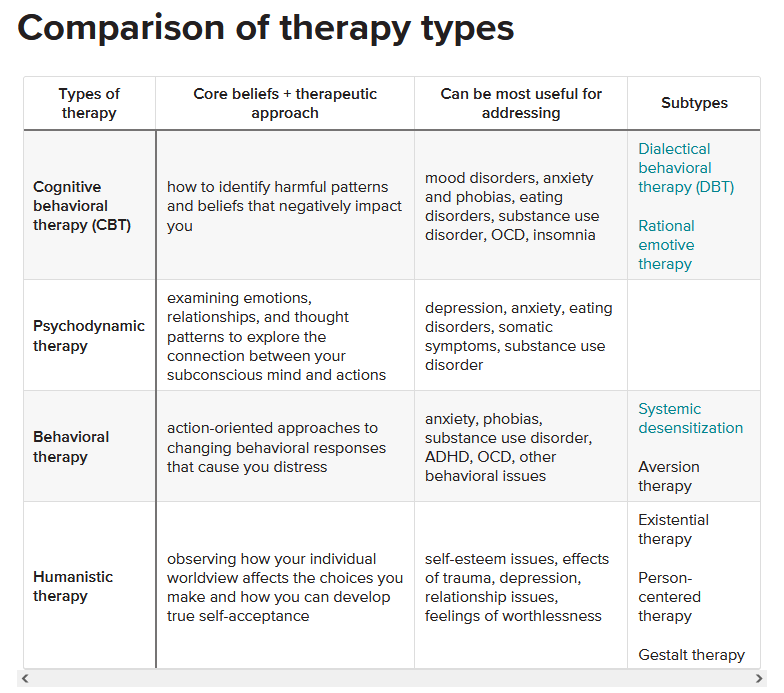
This comparison therapy chart is useful to see the different modalities. I personally believe that most of these have use within misophonia coping skills (albeit some more than others, and obviously never exposure therapy). It is my belief that a practitioner treating misophonia needs to be eclectic and willing to bend their theory and perspective based on the person in front of them—this is even more true with misophonia where we are alleviating symptoms rather than removing the misophonic response.

  • Source: https://www.healthline.com/health/cognitive-behavioral-therapy#techniques

If the person with misophonia is seeing their quality of life improve from a modality, then that’s the right choice, no matter what that modality is. I personally like a mix of sensory regulation, CBT, psycho-dynamic, humanistic, and solution-focused, with some narrative therapy sprinkled in.

Much of my disdain for CBT is not from CBT as a therapy, but rather, the practitioners who are arrogantly proclaiming themselves as “experts in treating misophonia”—to this date I do not think a single expert exists, especially since misophonia is such a newly recognized condition. Yet, I think it’s important for the record to show that I am NOT against CBT, in-fact, Misophonia Matters includes an entire cognitive section.

March 26, 2024 0 comments
1 FacebookTwitterPinterestEmail
c byddkzqy0
AdvocacyAwarenessCoping

Why Do I Support a Disability and Advocacy-Based Approach For Misophonia?

by Sensory Diversity March 23, 2024
written by Sensory Diversity

Persons with misophonia are suffering from a lesser-known condition and thus might need support with family, friends, and the medical community. It is not enough to simply help persons with misophonia cope with the aversive response to stimuli as this is recurring and can cause issues in every area of the person’s life.

Far too much of the current literature surrounding misophonia considers the misophonic person to be the problem which must be alleviated or fixed. While there is of course a need for coping skills and for the person with misophonia to be able to live their lives less impeded by this condition, there should be more room to consider misophonia a disability and a less aggressive approach toward research, treatment, and conceptualization of misophonia.

Early press on misophonia from 2012 to the 2020s focused on the strange nature of the condition and further imposed a view as persons with “chewing rage” “misophoney” or some behavioural failure that could be adjusted if they just CBT’d a little harder. Even Dr. Phil was abusive toward persons with misophonia who were practically begging for recognition and help.

Many of this is the reason for writing the Misophonia Matters approach. As a sufferer of misophonia and an advocate who was present for much of this debacle, I worry that misophonia sufferers even today are lost in a trap where they feel like they are the problem, and have even heard clinically from clients a feeling of ‘I am crazy’ which permeates through much of the misophonic population. Those with misophonia are not CRAZY and in-fact, I’d like to point out that since there is likely a neurophysiological brain processes and not cognitive, that there really isn’t any justification for the crazy moniker. There is, however, evidence that persons with misophonia are suffering from a debilitating condition that can impact each and every part of their lives – home, family, work, school, medical needs, friendships, hobbies. There are few areas of life that are not impacted by having misophonia.

Practitioners, researchers, and persons with misophonia must lead the charge in providing an adaptive coping skills approach for misophonia that includes advocacy based skills and an understanding that first and foremost, persons with misophonia need to be accommodated and treated in a compassionate matter. All of this led me to develop the Misophonia Matters approach, but I do suggest that regardless of your theoretical background or lens, that you put the feelings and needs of misophonic clients above all else.

Misophonia Coping Skills Class with Shaylynn Hayes-Raymond

Misophonia Matters is an advocacy-based coping skills class, book, and workbook for adults, teens, and clinicians by long-time advocate Shaylynn Hayes-Raymond. Shaylynn has been advocating for misophonia since 2015 and moved to a career in counselling based on her experiences as a misophonia advocate and sufferer of the disorder. The Misophonia Matters approach includes advocacy, psychoeducation, sensory-based skills, and cognitive and psychological skills. Worksheets are presented throughout the program. Central to Misophonia Matters is the idea that while we cannot treat and prevent misophonia, we can learn to navigate and adapt to our world through accommodation, coping skills, and an empathetic advocacy-based approach.

Take the class on demand. Or, find a live class.

March 23, 2024 0 comments
1 FacebookTwitterPinterestEmail
creative cloud single app plan
Developer Accessibility

Sensory Concerns in Adobe Software Such as Photoshop, Illustrator, InDesign, and Acrobat

by Sensory Diversity March 3, 2024
written by Sensory Diversity

Below is a letter that I have written to Adobe based on sensory considerations for their software. If you have issues with adobe software, please email them and let them know!

To Whom it May Concern,

I am emailing you on behalf of The International Misophonia Foundation (and Misophonia International), a non-profit based in Missouri. As an advocate for this disorder, as well as a clinician, I have several concerns about adobe products and their accessibility features (and lackthereof) for persons with sensory disorders or neurological disorders such as misophonia, sensory processing disorder, ADHD, epilepsy, and autism. At present, all Adobe products including Acrobat, Indesign, Illustrator and Photoshop, do not allow for Windows settings such as not having a blinking cursor. Ignoring these accessibility features is disheartening. Reduced motion of buttons and features is another problem we often face. Right now, the main issue in the Adobe software is ignoring Windows keyboard settings and overriding with a blinking cursor.

PLEASE CONSIDER CHANGING THIS TO HELP OUR COMMUNITY.

Sincerely,

Shaylynn Hayes-Raymond

March 3, 2024 0 comments
0 FacebookTwitterPinterestEmail
Gaming

Palworld is a Fun Game, But Needs Accessibility Features

by Sensory Diversity February 19, 2024
written by Sensory Diversity

This is not meant to be a hate post, more a plea to get sensory accessibility in the game so that this community can join in on the fun! Palworld is a newly released Early Access game on steam which combines elements of Survival and Monster-hunting/catching type games.

UPDATE: February 19th, 2024

As mods have been coming out, two amazing modders have so far come up with some accessibility features for Palworld. The first mod is a UI overhaul, which in particular addresses the blinking arrows when hovering items, allows for more colors/scaling, and other tweaks. The second mod gets rid of the spinning animations when throwing pals and pal balls! Both mods are absolutely amazing!

The first thing I’ve noticed with Palworld is the lack of accessibility features, which is something that I’m unimpressed with since this game has been receiving a lot of attention. I do think these features should be added including the ability to turn off UI blinking features (like those surrounding the buttons). There is no practical reason for these features, yet they are distressing for people with autism, sensory processing disorder, and other persons that have issues with visuals. I do appreciate the ability to turn off the motion blur and shake-scales as these would be absolutely abhorrent for persons with sensory disorders.

The ability to change the UI to be more sensory-friendly is something that many modern video game companies are not taking into consideration when building games for a general public. This leads to distress levels for players who have sensory issues, and thus makes it harder for a huge portion of the market that might want to play the game (autism, adhd, sensory processing disorder, misokinesia) that make up a huge portion of the population.

The loading icon is also something that is hard to handle for persons with sensory disorders.

There are numerous little UI features and game features (basically anything that obnoxiously blinks to get attention) that could be reduced or removed with an “accesibility feature”.

Furthermore, an option to turn off sounds like chewing, whistling, howling would be beneficial for these communities as well.

Other accessibility features that would be nice are color blindness settings and text size settings (for visually impaired).

You can view a review of the game here.

If you are concerned about this, please contact the developers: https://forms.pocketpair.jp/palworld

February 19, 2024 0 comments
0 FacebookTwitterPinterestEmail
5638748
AwarenessCoping

Why People With Misophonia Don’t Like Holidays

by Sensory Diversity December 26, 2023
written by Sensory Diversity

Misophonia during family events can be a catalyst for emotional turmoil. This is something that can be hard to understand if you do not have the disorder and have never experienced the fight-flight-freeze reaction that comes with sensory stimuli. For family members that don’t understand the condition, this can seem like the person with misophonia is not enjoying family time, or like they are not valuing the connections with their family. This is an unfortunate misconception, as persons with misophonia are just as likely to value family time and get lonely as people without misophonia.

So… what does misophonia actually feel like? Imagine you are locked in a room with a snake. Then, imagine there are bright lights and sirens going off at different times. For people with misophonia, legs shaking, jewelry clanking, chewing dinner, Christmas lights, and numerous other stimuli can cause a reaction that other people might never think about. As we stay in that room with the snake, our bodies become tense, our palms sweat, and our heart rate rises. Eventually, we may feel a physical sensation and pain, while the tension becomes both mentally and physically unbearable.

This feeling does not go away until we are away from the stimuli. This is why people with misophonia often leave early, flee, or try to spend time in another room alone—seemingly avoiding their family. People with misophonia might hide or take frequent naps if the gathering is in a place that allows this. This is not a way to stay away from family, but the nervous system becoming so taxed and so unbearably overloaded, that the only option to avoid feeling sicker and in more pain is to flee. For some, this can translate to migraines or flu-like symptoms for days after the event. The cost of staying in the room with a trigger and “sucking it up” can be high for individuals with misophonia and is something that is even harder to explain because without living it, it almost seems dramatic.

If a person with misophonia tells you something is triggering them, they do not mean it is “annoying” and they do not mean that they are simply “bothered”. Instead, what this means is that this stimuli is overloading their nervous system and causing more pain each time it happens, eventually becoming so intense that the consequences of not leaving become more lasting as time goes on. Essentially, misophonia is a full-body experience that leaves us so tired, so exhausted, and so physically and mentally sore, that we may try to avoid this experience altogether and become withdrawn.

Please don’t think that your family member who doesn’t enjoy gatherings doesn’t love you. This condition is very hard to manage, and holidays often bring more stress, and more sensory stimuli than any other time of year. For persons with misophonia, we are stepping outside of our safety and comfort in many ways, and for many of us we will not be able to calm down until we are able to get back to our routines. These routines have been developed out of necessity, as they are our general ways of adaptive coping with misophonia.

December 26, 2023 0 comments
1 FacebookTwitterPinterestEmail
Newer Posts
Older Posts

Sensory Diversity is the recognition that every individual perceives, filters, and responds to the world in a unique way. While neurodiversity celebrates the different ways we think, sensory diversity focuses on the gateway to those thoughts: our senses.

Social media infographics and posts are not a reflection of the views of the site owner or individual site authors. These posts come from a variety of sources and reflect numerous viewpoints through the sensory and neurodiversity community.

Recent Posts

  • Sensory Accessibility Suggestions for World of Warcraft
  • When It Isn’t ADHD or Autism: The Lost Tribe of Neurodivergence
  • What It’s Like Living With Misophonia
  • How Misophonia Actually Feels for Sufferers
  • What is Sensory Dysregulation?

Recent Comments

  1. Lilian on Misokinesia
  2. admin on Misokinesia
  3. Dense Caldwell on Misokinesia

Product links may be affiliate links. This site makes a small commission off these links.

  • Facebook
  • Instagram
  • Linkedin
  • Tumblr

@2021 - All Right Reserved. Designed and Developed by PenciDesign


Back To Top
Sensory Diversity
  • Home
  • Blog
  • Neurodivergence
    • What is Autism?
    • What is ADHD?
    • What is Sensory Integration / Sensory Processing Disorder?
    • What is Misophonia?
    • What is Misokinesia?
  • Sensory Lifestyle
  • Sensory DIY

Shopping Cart

Close

No products in the cart.

Close