Sensory Diversity
  • Home
  • Blog
  • Neurodivergence
    • What is Autism?
    • What is ADHD?
    • What is Sensory Integration / Sensory Processing Disorder?
    • What is Misophonia?
    • What is Misokinesia?
  • Sensory Lifestyle
  • Sensory DIY
  • 0
7176297
CopingResearch

CBT is a Coping Skill Not a Treatment for Misophonia

by Sensory Diversity December 9, 2023
written by Sensory Diversity

As scientists run around telling the world that the “treatment” for misophonia is Cognitive Behavioural Therapy, I think it is important to note that any findings on CBT that have been seen are akin to that of a coping skill — they help deal with the emotional after-effects of misophonia, not the misophonic moment, and certainly not as a preventative measure. You cannot CBT the misophonia away, and you surely should not be out there referring to CBT as a ‘treatment’ for misophonia. This is a disingenuous move by researchers, clinicians, and those involved in the use of CBT to skew public perception on CBT.

I am not saying that CBT is not helpful for misophonia. Like all coping skills approaches there is room for CBT in the room when we are trying to help people with misophonia mitigate the after-effects of the disorder and learn how to live in a world that is not accommodating to their sensory needs. Yet, this does not mean that CBT is the be all and end all, and it absolutely does not mean that we should be toting things like exposure therapy (if exposure worked we’d all be cured, none of us can completely ignore stimuli). Misophonia is also not a behavioural disorder. We do not learn to hate sounds and we cannot learn not to. In fact, saying that misophonia is “hatred of sounds” in general is untrue because there is already proof that there is a brain basis and the amygdala and fight-flight are involved (Kumar, 2018).

I understand that scientists are using the language they are used to, but they should be cautious when explaining any cognitive based, or even sensory-based skill for misophonia as a “TREATMENT”. The very word treatment assumes that misophonia can be mitigated by the skills learned, and that is simply not true. CBT is helpful to take the edge off and learn how to understand misophonia through worksheets and psychoeducation, but that does not mean that it should be referred to as a treatment. In-fact, I’d wager that calling anything a treatment at this point in time is nothing more than wishful thinking.

Much of the problem, I assume, is the reliance on “treatments” in American medicine and ‘psychiatric care’. The use of insurance codes means that specific interventions must be referred to as a treatment to be approved for use and reimbursement. Frankly, this entire practice is backwards and wrong, and is why in places like Canada where I live this is unheard of and only muddies the waters when it comes to the expectations of those receiving these “treatments”. Instead, practitioners and researchers should be honest and explain CBT for what it is, a coping skill for the disorder, and not the be all and end all approach to helping sufferers.

References

Brout, J. J., Edelstein, M., Erfanian, M., Mannino, M., Miller, L. J., Rouw, R., Kumar, S., & Rosenthal, M. Z. (2018). Investigating misophonia: A review of the empirical literature, clinical implications, and a research agenda. Frontiers in Neuroscience, 12, https://doi.org/10.3389/fnins.2018.00036

Kumar, S., Tansley-Hancock, O., Sedley, W., Winston, J. S., Callaghan, M. F., Allen, M., Cope, T. E., Gander, P. E., Bamiou, D., & Griffiths, T. D. (2017). The brain basis for misophonia. Current Biology, 27(4), 527–533.


Misophonia Coping Skills Class with Shaylynn Hayes-Raymond
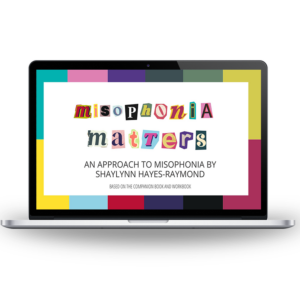
Misophonia Matters is an advocacy-based coping skills class, book, and workbook for adults, teens, and clinicians by long-time advocate Shaylynn Hayes-Raymond. Shaylynn has been advocating for misophonia since 2015 and moved to a career in counselling based on her experiences as a misophonia advocate and sufferer of the disorder. The Misophonia Matters approach includes advocacy, psychoeducation, sensory-based skills, and cognitive and psychological skills. Worksheets are presented throughout the program. Central to Misophonia Matters is the idea that while we cannot treat and prevent misophonia, we can learn to navigate and adapt to our world through accommodation, coping skills, and an empathetic advocacy-based approach.

Take the class on demand. Or, find a live class.

December 9, 2023 0 comments
0 FacebookTwitterPinterestEmail
gwdohsbt ou
AdvocacyCoping

Reduced Motion as a Developer Option is Useless

by Sensory Diversity December 9, 2023
written by Sensory Diversity

Reduced Motion settings, whether they are for browsers, or for Windows/Mac or phone systems are effectively useless. I am not even sure what motion that these settings are removing because for the most part hovers, blinking/flashing/spinning loading spinners, and cursor blinks are ever-present. At the end of the day, for persons with sensory disorders there is pretty much nothing that is stopped by the Reduced Motion setting that is actually useful for people who prefer a device that isn’t giving them nausea, headaches, and at worse a painful fight-flight reaction.

If you google “reduced motion” you find several reports of developers trying to circumvent the option and never work– which is even more disturbing than the current uselessness of Reduced Motion. For those with problems with sensory integration, autism, or misokinesia, we are in a dire need for a Reduced Motion setting that is actually “no motion”. There is absolutely no reason why developers cannot accommodate this, other than their belief that “things should look cool”.


December 9, 2023 0 comments
0 FacebookTwitterPinterestEmail
f9dfujos9eu
Treatment

Have you tried exposure therapy or behavioural therapy?

by Sensory Diversity December 7, 2023
written by Sensory Diversity

Some people with misophonia have told me (Shaylynn) that they have tried therapies for misophonia that they felt made the condition worse. With that in mind, I have decided to run a poll to see how common this is. I personally wonder if scientists and clinicians should be using certain therapies if they are not helping long-term with the disorder. For example, what if misophonia is not behavioural and not cognitive? Then, where do we go from there when people have already been exposed to therapies that frustrate them, hurt them, or scare them off potential treatments as they come?

[gravityform id=”20″ title=”true” description=”true”]

December 7, 2023 0 comments
0 FacebookTwitterPinterestEmail
Uncategorized

What are Misophonia Triggers?

by Misophonia International November 22, 2023
written by Misophonia International

Triggers for misophonia are unique to the individual. However, there are some that been reported by many. This does not mean one person will have all the triggers, or that they will not have other misophonia triggers. Misophonia triggers are events that set off the fight/flight/freeze portion of the brain. Since misophonia is most-likely neurological, the more you hear these triggers, the worse the condition gets. The brain, for whatever reason, has now identified these events as a threat.

Common Audial Triggers

  • Whistling
  • Tapping
  • Chewing
  • Breathing
  • Scraping
  • Sirens
  • Barking
  • Yelling
  • Plates clinking
  • Shuffling noises
  • Pen clicking
  • Clock ticking

Common Visual Triggers

  • Tapping
  • Leg-shaking
  • Finger movements
  • Chewing
  • Swaying

Because misophonia triggers differ from person to person, it may be exhaustive to have a total list. However, this page exists to help persons that are unsure of the nature of the disorder. Persons with misophonia may have only a few triggers, or many, and they may worsen as time goes on.

Do you have triggers that weren’t included on this list? Please include them below, and we will update the article with your suggestions.

November 22, 2023 0 comments
4 FacebookTwitterPinterestEmail
Advocacy

Misophonia Autism Connection

by Misophonia International November 22, 2023
written by Misophonia International

Unfortunately for misophonia there is currently no diagnostics code, or enough preliminary research to conclude whether or not there is a genuine connection to autism. On the surface, there are some similarities that are important to explain. Whether these connections are due to a brain and body explanation, or are merely pertaining to the impact on life quality, these associations are important.

“Whether or not there is a misophonia autism connection remains unclear, but there may be factors that warrant further study.”

misophonia autism connectionAccording to Autism Speaks, Autism is defined as the following: “Autism, or autism spectrum disorder, refers to a range of conditions characterized by challenges with social skills, repetitive behaviors, speech and nonverbal communication, as well as by unique strengths and differences. We now know that there is not one autism but many types, caused by different combinations of genetic and environmental influences.”

Misophonia, like autism and other spectrum disorders, is likely to be a condition that shows a number of influences. As of now, there is not enough evidence to say whether or not it will exist on a spectrum, have genetic connections, or how great the psychiatric or mental health components of the disorder are. This does not mean that misophonia will or will not be connected to autism. However, the important distinction between these disorders is to show the similarities in sensory processing behaviour. Whether or not there is a misophonia autism connection remains unclear, but there may be factors that warrant further study.

Like sensory processing disorder, children with autism become easily overwhelmed by stimuli. Loud noises can be harmful to an autistic child, and they can become irate, or even unable to function around the sounds. This is certainly similar to misophonia. However, it is unclear if the auditory over-responsivity of these two conditions is based on the same brain function. The fact remains that both misophonics and autistics are often heavily impacted by noise.

Exploratory research in the future could settle these distinctions once and for all. In the meantime, it is important to realize that while children with misophonia and autism may both experience difficulties with sensory sensations, autism is a neurodevelopmental disorder that has implications that reach far beyond the sensory processing system.

What is particularly interesting with auditory gating and sensory disorders, is that they are likely to be neurological. Because of this, it is important that researchers are open-minded when considering the implications for several disorders that are brain-based and have a sensory component.

November 22, 2023 0 comments
1 FacebookTwitterPinterestEmail
AwarenessMisokinesia

Misokinesia: Misophonia Visual Triggers

by Misophonia International November 22, 2023
written by Misophonia International

I’d like to first start by saying that misokinesia (hatred of movement) is a term that oversimplifies things. Research-wise, there’s not enough to go on to say whether or not visual triggers are different from misophonia. They might both be related, they could be part of SPD, or they could be two interlinked disorders. The research simply isn’t there. We also don’t know whether or not all, most, or some sufferers also have visual triggers. For the purpose of this I am just going to use “visual triggers” or “visual stimuli”. I’m not going to simply attribute it to a name or disorder before there is proper research.

My visual triggers are just as hard to handle as my audial triggers. Sometimes they are worse. I find it nearly impossible to escape a sight in the room. Even when I close my eyes, and even hours or days later, the memory is still there. I want to cry as I think of these triggers. Legs shaking, people swaying, fingers and toes tapping. Even improper grammar have been known to become triggers. Double spacing after periods is so intensely anguished, that I’ve had to block people from communication.

I’ve had people tell me, that have misophonia, “You can’t have visual triggers, or be triggered by grammar”. This has been frustrating. As I fight tooth and nail for advocacy, to be told by my own community that I am “wrong”.

Having severe visual and audial triggers has made life more challenging. The grammar and typing, and light effect triggers are so severe that I find it nearly impossible to surf the web, play video games.

I have the following strange, and life-altering visual triggers:

  • Two spaces instead of one after a period
  • Use of “u” “r” or “ur” instead of full words
  • You’re/your used improperly
  • An overabundance of punctuation, especially “!”
  • Legs and arms in places that are strange to me (one leg up, one down)
  • Arms leaning across car doors
  • Untied shoelaces
  • Effects in video games
  • Bright lights
  • Pinwheels, windmills, and all other “rotating” circles
  • Bags (being swung on an arm)
  • Anything flipping or breezing
  • Words used improperly
  • An improper ellipsis (more than 3 consecutive dots …)
  • An over use of ellipses.
  • Chewing (the visual, no sound necessary; actually I am bothered more by the look than the sound)

Do you struggle from similar? For me, visual triggers have been harder to explain because even our own media doesn’t do enough to explain. Of course, I can’t fault us – there simply isn’t enough data (scientific or otherwise). Sometimes it’s hard to handle visual triggers because I can’t wear earplugs for my eyes. I suppose I could wear a blindfold, but this has impractical applications. I am also more likely to remember visual triggers and never want to go back to the place. If I have been visually triggered somewhere in the past, I will not want to go back.

I have had dreams of these triggers. I have had waking nightmares. These visuals are so deeply intertwined in my brain that they haunt me, like a ghost. Sounds might go away… but the visuals remain.

I have stopped having text conversations with many people because they don’t understand. I get it but it’s hard for me to socialize. It’s become further isolation atop of my isolation. I’m not sure what the answer is, but one thing is for sure, we need more research (and don’t worry, we’ll fight for that!).

[socialpoll id=”2499030″]


November 22, 2023 0 comments
1 FacebookTwitterPinterestEmail
jupoxxrndca
Coping

Does the Ketogenic (Keto) Diet Help Misophonia?

by Sensory Diversity October 26, 2023
written by Sensory Diversity

I have been on the ketogenic diet for several months, and I wish I could say that suddenly my misophonia had disappeared and that the cure I needed all along had been to simply change my diet, but that is simply not true. While the ketogenic diet has been shown to be helpful for epilepsy (D’Andrea, 2019), we do not know enough about the brain to know whether ketosis is something that can be helpful for misophonia. More importantly, misophonia itself is something that seems to be multi-faceted when it comes to the brain and body (Kumar, 2017).

At this point, I can tell you both from my anecdotal experience and the lack of scientific evidence that the ketogenic diet cannot be considered a treatment for misophonia. Yet, this does not mean that there are no benefits that can be had for persons with misophonia. Importantly, when the body is in distress, misophonia is worse. For those who are obese, have certain food allergies, or feel sluggish due to dietary concerns, finding a diet (any really) that changes their physiological state for the better can reduce the impact of distress after leaving a triggering situation. The better you feel over-all, the easier it is to calm down.

Over-all health is important for misophonia because we only have one nervous system and one body, and any positive change is beneficial for your long-term coping. That is not to say that the ketogenic diet is the “right” choice, merely it is the right choice if a person determines that they have a good experience on the diet. This should always be done with the consultation of a medical professional and dietician, because the diet is such an important tool for health and wellbeing.

For me, dietary choices were more about over-all health than misophonia. I haven’t noticed my triggers lessened by the diet, but I do have more energy than I did before—which is helpful for an overtaxed nervous system.

October 26, 2023 0 comments
0 FacebookTwitterPinterestEmail
3356489
Awareness

Misophonia “Manipulation” Isn’t Manipulation, It’s Adaptation!

by Sensory Diversity October 17, 2023
written by Sensory Diversity

For parents of misophonic children, romantic partners, friends, and educators, some traits of misophonia might look to them as a manipulative behaviour. For those with misophonia, when we are in fight-flight-freeze and dysregulated, our brains and bodies are telling us to do anything to stop the trigger—just as I imagine one would in any scenario that the brain and body have earmarked as a threat. It should be no surprise that when faced with an extremely aversive reaction to sounds (or visuals), that a person with misophonia would go to extreme lengths to stop the noise. Examples of this might be coming up with alternative explanations to try and force the event not to happen. For example, one might say they cannot go out because they have to do x, y, or z. Or, perhaps a partner goes to great lengths to avoid date night, even cancelling with excuses. Maybe the person comes up with a story for why something cannot be in their presence—for example, they might respond to gum chewers my saying that they are allergic to the smell. A parent with misophonia may tell their child that their loud chewing is rude, which is socially true in many circumstances, but this might not be the motivation for the request.

On the surface these behaviours might seem manipulative. The definition of manipulate is to, “control or influence (a person or situation) cleverly, unfairly, or unscrupulously.” The key point here is the unfairness or unscrupulously. For persons with misophonia it is not control of the other person that they want to achieve, but to alleviate or prevent a misophonic reaction. This behavior is adaptive. People with misophonia are used to being ignored, ridiculed, and told that their condition isn’t real. Even those who are supported might deal with guilt for asking others to stop a behaviour due to misophonia, and thus might rationalize an excuse that is to them more “logical” even if the receiving party suspects the misophonia is the cause.

An important part of misophonia is learning to self-advocate and adapt with the condition. However, for some, it can be harder, especially if the other party is not open to learning about their condition or accommodating. Instead of thinking people with misophonia are manipulative, let’s consider that maybe they are just trying to avoid the neurophysiological reaction, and not the person making the trigger.

October 17, 2023 0 comments
2 FacebookTwitterPinterestEmail
iqpr1xkf5f0
Research

Interview with Dr. Ali Danesh Regarding Accommodations at Schools and Universities for Individuals With Misophonia

by Sensory Diversity October 8, 2023
written by Sensory Diversity

Could you tell us a bit about yourself and your work?

I have been working with children and adults with decreased sound tolerance disorders such as hyperacusis and misophonia for many years. In a paper that we published a few years ago we looked at the underlying physiologic, psychologic, neurologic, and audiologic features in misophonia. The research by the scientists show that misophonia is a unique phenomenon occuring within the brain that results in significant reaction to certain sounds. Children and adults with this condition usually do not show significant disturbance of their mental health. However, being exposed to acoustical triggers such as chewing, and other biologic sounds can generate significant emotional and cognitive reactions. These reactions in turn can limit the person’s productivity, participation, and progress in both academic and daily life environments.

What has your work in Misophonia been on?

We have emphasized the role of educators on the academic presence and existence of students with misophonia. It was noticed that those with misophonia have a tendency to leave school or limit their participation. We wanted to know how we can keep the students in the schools and be responsible to their needs as academicians.  

Editor note: find the accommodation study here: https://files.eric.ed.gov/fulltext/EJ1228969.pdf

You published a study on Misophonia accommodations in college—what was your experience with this?

As I mentioned earlier our goal of the research was to find ways to keep students participating in the classroom. The main idea of the research was to explore if the university faculty members know about misophonia and whether they are aware or not, would they provide accommodations for students who cannot stay in a classroom because of certain sound triggers such as chewing. The results of the study showed that although many of the faculty did not know about misophonia, the majority of them had no objection in providing accommodations such as classroom eating rules, quiet rooms for exams, and use of earplugs or personal noise generators if necessary. This complies with the idea of “no child left behind” and it should be the mission for every teacher who interacts with students with disabilities including those who suffer from misophonia.

Do you think accommodations for Misophonia could be harmful?

There is no evidence that accommodations for children and adults with misophonia in the academic environment can cause any harm to students. In our university the office of student accessibility services (SAS) provides support for students with misophonia and has never received any complaints from those who received accommodations!

October 8, 2023 0 comments
0 FacebookTwitterPinterestEmail
pexels photo 941555
Research

Seeking Editors and Peer Reviewers for Academic Journal

by Sensory Diversity September 11, 2023
written by Sensory Diversity

The International Misophonia Foundation is in the process of founding an academic journal for misophonia research. The largest part of this process is creating a fully-functional, open-source, peer review website and journal for academic papers. In order to succeed in this mission we will need Editors (academic), Peer reviewers (misophonia researchers), and Copy editors (grammar, style, spelling). If you are interested in applying for one of these positions, please use the following form to reply. Please understand that peer reviewers and academic editors MUST have a background in clinical counseling, academic research, or otherwise be engaged in the process of misophonia research. We will be accepting applicants from Master’s level and higher. PhD/PsyD students and MDs will also be accepted in these roles. For general copyediting, we do not require degrees, but a sample proofreading test may be sent.

Please note, these are volunteer positions. However, we will be willing to report volunteer hours to Universities or Job Referrals.

Please go here if you would like to apply: https://www.misophoniafoundation.com/seeking-editors-and-peer-reviewers-for-academic-journal/

September 11, 2023 0 comments
0 FacebookTwitterPinterestEmail
Newer Posts
Older Posts

Sensory Diversity is the recognition that every individual perceives, filters, and responds to the world in a unique way. While neurodiversity celebrates the different ways we think, sensory diversity focuses on the gateway to those thoughts: our senses.

Social media infographics and posts are not a reflection of the views of the site owner or individual site authors. These posts come from a variety of sources and reflect numerous viewpoints through the sensory and neurodiversity community.

Recent Posts

  • Sensory Accessibility Suggestions for World of Warcraft
  • When It Isn’t ADHD or Autism: The Lost Tribe of Neurodivergence
  • What It’s Like Living With Misophonia
  • How Misophonia Actually Feels for Sufferers
  • What is Sensory Dysregulation?

Recent Comments

  1. Lilian on Misokinesia
  2. admin on Misokinesia
  3. Dense Caldwell on Misokinesia

Product links may be affiliate links. This site makes a small commission off these links.

  • Facebook
  • Instagram
  • Linkedin
  • Tumblr

@2021 - All Right Reserved. Designed and Developed by PenciDesign


Back To Top
Sensory Diversity
  • Home
  • Blog
  • Neurodivergence
    • What is Autism?
    • What is ADHD?
    • What is Sensory Integration / Sensory Processing Disorder?
    • What is Misophonia?
    • What is Misokinesia?
  • Sensory Lifestyle
  • Sensory DIY

Shopping Cart

Close

No products in the cart.

Close