Sensory Diversity
  • Home
  • Blog
  • Neurodivergence
    • What is Autism?
    • What is ADHD?
    • What is Sensory Integration / Sensory Processing Disorder?
    • What is Misophonia?
    • What is Misokinesia?
  • Sensory Lifestyle
  • Sensory DIY
  • 0
portrait photo of smiling woman in black top and glasses wearing white headphones stockpack pexels scaled
Coping

Tips for Coping with Misophonia

by Sensory Diversity July 10, 2022
written by Sensory Diversity

While there is currently no cure for misophonia. It is important to note that coping mechanisms can be very helpful. We communicate directly with misophonia researchers to ensure that there will be a cure sooner rather than later. However, in the meantime there are some great things you can do to help keep yourself calm. Misophonia coping tips can help you live a meaningful life, despite your condition.

There are some misophonia coping tips that can be helpful.

  1. TAKE A COPING SKILLS CLASS!
  2. Find professionals that understand, or at least are empathetic to your disorder. Misophonia Providers works in association with the Misophonia International Research Network and is a growing list of professionals across the US that understand the disorder. While the list is small, it is always growing.
  3. Do not be too hard on yourself. You do have a real condition and while it is not yet well-received by the world, it is okay that you are unable to attend every function. By accepting yourself, you may be able to cope better.
  4. Have meaningful conversations with family and friends to garner their support. If a person loves you, they should not want to hurt you. Share resources with them so that they understand you are not lying, and hopefully, they will come to terms with your disorder.

In this video, I’m going to share 5 Tips for Misophonia Coping that I personally use on a day to day basis.

I apologize for the sound quality of some of these videos. While my condenser microphone and tripod (both at once, yes) continue to be jerks… we’re going to have a bit of a rocky ride. I hope to have something a little more formal set up within the next few months.

Misophonia can be hard to cope with. We all know that. But, how do I cope? This video summarizes my misophonia coping tips. I didn’t mention everything, but I’ve found these steps to be very helpful.

  1. Earplugs paired with music
  2. Adjusting my position in a room to ensure I am not triggered (or where I sit on a bus)
  3.  Prepare in advance for intimate experiences that will have triggers (such as family dinners). You should explain to family/friends about the disorder (but don’t do so when triggered)
  4.  Manage stress (unwind, watch movies, take baths)
  5.  Leave the situation if you can

I fully understand that not everyone can react to situations in the same way. I encourage you to stand up for your health and find out what helps you. Once you’ve discovered this, you should advocate for yourself and try to find the best balance you can. In order to deal with this disorder, we’ve got to have our own backs. These misophonia coping tips are only meant to help you consider your options. You should talk to a medical professional about any lifestyle changes you may want to make.

https://misophoniaeducation.com/product-category/workshops/

 

July 10, 2022 0 comments
0 FacebookTwitterPinterestEmail
pexels photo 1879288
CopingParents

Who Decided Young Children Don’t Have Misophonia?

by Sensory Diversity March 31, 2022
written by Sensory Diversity

Most anecdotal and academic work states that misophonia begins in late childhood – early adolescence. I disagree. As of now researchers rely on self-report and/or reports from parents. However, how would a parent know what to look for in early childhood? How can we rely on someone’s memory when memory is so elusive? I would so much like to see a more developmental approach to misophonia research. Again, I am sharing my story to help parents understand what might be early symptoms of misophonia. Had I not also had misophonia I may never have figured out that my child also had it. At this time, misophonia still had no name.

As infancy rolled into toddlerhood, as life’s demands became more challenging, for each of my triplets (yes I have triplets), it became more obvious to me that one of my children was struggling with something that made her seem moody and highly insecure. She was always sensitive to sound, and other sensory stimuli. However, By age 21/2-3 we encountered what I called the “chewing problem.” Remember, at this time misophonia had not yet been named.

One day, as a family, we were eating our dinner. I recall, with great detail, my child picking up her plate of food with an agonized expression. Through her pain, she was trying to balance her plate with one hand as she dragged herself with her other arm across the floor out of the kitchen on her knees until she got to the next room, where she then sat up and continued to eat. Perhaps this is what misophonia looks like in its most basic form. That is, prior to labeling it as a problematic “behavior” or personality issue.

I still remember thinking how odd this was to watch. My child could walk. Yet, she dragged herself looking like a wounded animal in pain trying to covertly escape predators. I had not seen what had built up to this, as I was at the counter, likely to have been rapidly dishing out rainbow Jell-O.

At this point, I thought, “Okay, I’m not making a big deal about this because…well, I have three baths ahead of me and if she’s eating her dinner, who cares where she’s eating it? You’re a mother of triplets!” As my kids’ wonderful pediatrician always said, “Pick your battles”.

This then became a nightly occurrence. After a week I tried to get her to sit back at the table but she became very upset, angry, and frightened. I could feel what she was feeling in my gut. Empathy. It wasn’t good. Again, my instinct was to let her eat in the hallway. So I said, “If you are more comfortable in the hallway, eat in the hallway, it’s okay.” She said, “Okay, thanks.” My goal, again, was to get my three kids to consume a healthy meal so that they were nourished, and I wasn’t all that concerned as to where they did it.

Fast forward…a few months later, it had become quite clear that none of us could eat around her at any place, at any time. “STOP CHEWING” she would scream. She had taken to putting her little hand over my mouth while I ate and attempted to do the same to her siblings. Suffice it to say, her siblings did not appreciate this gesture.

What was going on here? Eventually, it got to the point that we were unable to go on long car rides that involved food or beverages. If anybody wanted a drink, that would set her off. “NO! NO!” she would scream, and her little body would shake. My heart broke as I watched her siblings, with whom she was so close, bewildered as to why they were continually being yelled at for doing things that were normal everyday activities.

As time went on, things got worse and as I observed my child, I had an idea. I had an idea that she was like me. I realized that like me she was reacting to sounds. This began my journey into finding out what this was all about.

March 31, 2022 0 comments
0 FacebookTwitterPinterestEmail
pexels photo 236164
CopingParents

Parenting, Babies, and Misophonia

by Sensory Diversity February 14, 2022
written by Sensory Diversity

In January 2021, I learned I was pregnant. I was excited, anxious, and embracing the changes my body was going through. Being known as “mommy” was something I simultaneously craved and felt weirded out by. My emotions were–and still are–all over the place. But the high I felt while pregnant was all over by the time my little one was home with my husband and I for 24 hours.

The intensity of my misophonia stayed about the same during my pregnancy. There were days when I was more sensitive to it than others, but I was more focused on dealing with morning sickness, sciatica, and the constant kicking of the child in my womb. I pretty much vomited throughout my pregnancy and grew very sensitive to car movement. Car sickness was a regular occurrence.

I gave birth late September 2021. There were hardly any times when my misophonia was an issue. I guess I was in too much pain to really care. I did not get an epidural and gave birth naturally. I only took Motrin from time to time and was injected with morphine during the last stretch.

I was in labor for 24 hours. I pushed five times when the time came, and my baby was out. It hurt like hell. But baby had arrived and I experienced temporary relief.

I was determined to breastfeed. I wanted to give my baby optimal nutrition. But my sensory issues had other plans.

I was two weeks in to breastfeeding and I quit. My sensory issues didn’t let me do what I wanted to do for my baby. During this time, I didn’t feel human. Every time my baby breast fed, I wanted to rip my skin off. Every time my baby touched my breasts, I wanted to die. I hated myself, my life, and almost seriously considered giving my baby up to someone else.

I switched to formula after a huge meltdown in front of my husband, who didn’t realize how bad breastfeeding was treating me. He wanted me to transition slowly but I just couldn’t. I needed to stop NOW, or I’d drive myself off a cliff. I don’t think I was kidding. I was that desperate. I don’t think misophonia was my biggest problem anymore.

Along with those feelings, I also couldn’t hold my baby for long periods of time. If I did, I’d get severely overwhelmed and my husband would have to step in. That’s how bad my sensory issues are. Touch is difficult for me, and all of that touching and stimulation from breastfeeding was making me go insane. Eventually, my husband did practically all the holding. Even now, though I’m a lot better, he holds the baby often. My doctor diagnosed me with PPD/PPA and upped my medication dose.

As the weeks turned into months, coping with Misophonia while also caring for a child was proving to be rather difficult. Now that I wasn’t breastfeeding and hating myself all the time, misophonia became my primary issue again. The headphones that I used before baby were no longer practical. They were huge, needed some maintenance which was giving me trouble, and most importantly, would be a baby hazard eventually. They frequently slipped, sometimes off my head, and I didn’t want it to slip and fall on the baby. I didn’t have time to try fixing the headphones and trying to make the bulkiness work.

This means I mostly did without headphones. Sometimes this was fine, as I spent most of my days in my room or another room away from my triggering family member that loves with my husband and I. But there were days when I couldn’t avoid it and I was raging internally while making a bottle of formula.

Late this month (Feb. 2022) I invested in good quality, noise cancelling earbuds. I was going crazy not being able to drown out the noise around me as much as I wanted to. I got a refurbished pair of Bose earbuds. They’re only slightly uncomfortable, but ultimately very much worth the price. I put them in, play some white noise, and that’s all I hear. I can also listen to my favorite podcasts again without worrying about bulkiness, slipping, or baby trying to grab.

Baby is 4 months, almost 5, and is growing so well. Baby reached all kinds of milestones. Baby is learning to make me and my husband laugh by doing certain things. Baby is well loved and my husband and I have lots of support. It’s hard to focus on that when I have depressive/anxious episodes. Not long ago, I was crying in the middle of the night just from being generally overwhelmed. I have zero time to myself a lot of the time, or if I have a break from the baby, I need to spend that break doing chores around the house. This was stressful for me when I was still working. So I made a huge decision.

I decided to quit my job right after my husband also quit his job to go to school and get a better, enjoyable job. I decided I needed to spend my time at home with my baby and focus on housework. AKA, I decided to embrace the homemaker life.

I loved my job. It was run by a great boss, I had great coworkers and got so much help and leeway. But I decided having a job right now was not my calling. Now all I have to worry about is the home, my baby, and my husband. While I was working, I had to think about that along with who I was going to ask to watch my baby for several hours, wake up with enough time to get to said family member’s house and get to work on time, and keep an ear out for my phone in case the person watching baby needs me to pick him up early.

Being a working mom was never something I wanted, but I read about all these working moms, or have friends with kids who are working and seem to have it together, so I thought I could do it too. But I hated it. I hated being away from my baby for so long. I hated barely having time for myself, let alone looking presentable for the workplace. I’m fortunate I even have the choice of being a homemaker, because I’m sure there are moms out there who prefer that, but have to work. Sometimes I feel bad for even having a choice.

Despite how bad my sensory issues are and my misophonia, I can’t seem to be away from baby for long periods of time. My husband will always offer me opportunities to get out of the house and I almost always turn them down. I actually want to stay home. It’s…strange. But somehow feels right. It’s not that I don’t want to see friends, cause I do. But I just have different priorities.

All of this to say, I love my baby. I’m excited to watch him grow. And I look forward to teaching him everything I know about life.

February 14, 2022 0 comments
0 FacebookTwitterPinterestEmail
IMG 0691 scaled
Coping

My Misophonia-Friendly Wedding

by Sensory Diversity February 12, 2022
written by Sensory Diversity

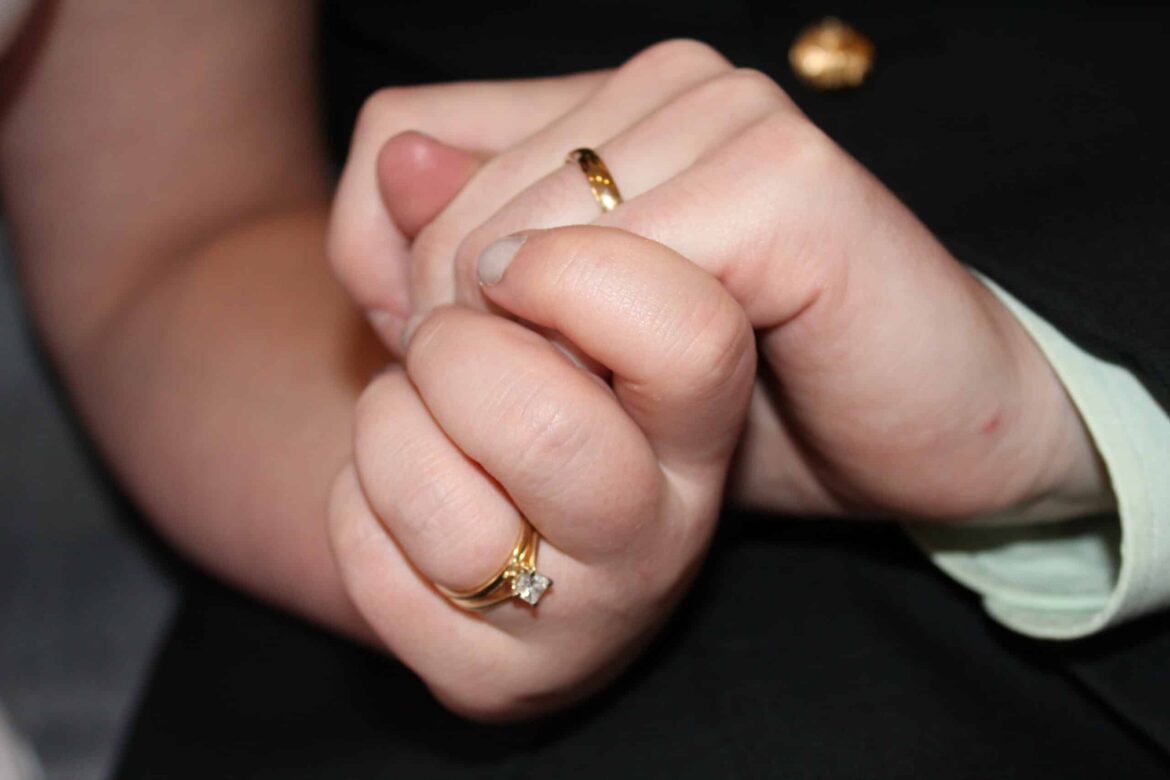
COVID-19 kind of sucks, but one great part about it is that nobody is currently expecting a big event. My now husband and I took advantage of this fact and had a very small wedding ceremony. I’ve always been haunted by the idea of a big wedding with everybody shaking their legs or making noises. I don’t even like going to weddings!

My entire wedding cost under $3,000. Dress included. So, if you’re looking for another excuse to have an exclusive affair, let cost be one of them. For the wedding we had 8 people including the officiant and photographer. It took place in a gorgeous little art-gallery in the heart of downtown- in one of my favourite cities.

I’m going to list all the reasons why my wedding was Misophonia-friendly, and maybe you can take some ideas. I just want to say that you should NEVER feel guilted into a big ceremony or an uncomfortable event because others want it. Your friends, family, and other loved ones should know you well enough to understand your (or your partner’s) needs, and simply be happy for you!

How my wedding was misophonia-friendly

  • We had a small venue with only 8 people
  • There was the ability to play music over loud speakers, which we left on during photographs which eased tension (and drowned noise)
  • I turned my back so I wouldn’t see potential triggers
  • All guests at the wedding knew about my misophonia and respected my condition
  • We filmed the wedding so that people could watch it online and still feel apart of it
  • I saved pieces of cake for people who were unable to attend
  • We had the “reception” in my living-room/diningroom (my husband helped decorate, it was so awesome)
  • If people wanted to send gifts we had an online Amazon registry

I hope your own wedding can be misophonia-friendly!

February 12, 2022 0 comments
0 FacebookTwitterPinterestEmail
Diaz MataixLeDoux ACNP2016 Poster LAST
Research

Important Misophonia Brain Research by Joseph E. Ledoux and Lorenzo Diaz-Mataix

by Sensory Diversity February 9, 2022
written by Sensory Diversity

Report on Findings of the LeDoux Lab by Jennifer Jo Brout

Joseph E. LeDoux

One of the working theories related to mechanisms underlying misophonia is that auditory stimuli may be misinterpreted by the brain as dangerous, or threatening. As such, the brain responds as it would if it were actually in danger. When we are in danger, our  freeze/fight/flight system[i] is set off. When this happens, our autonomic (involuntary nervous system) is activated, or aroused.

When our involuntary nervous system is aroused physiological and other hormonal changes occur (e.g. blood is redistributed throughout our bodies, the heart rate raises, etc. ) to enable us to “flee” from the apparent danger or “fight” if we must.

This is a system that all mammals have that has been conserved by evolution.[ii]  The feelings we have as a result of the fight/flight system being activated are associated with “wanting to get away from the offending stimuli (sound, or visual), or irritation, anger or rage. In other words, the irritation, anger and rage that we feel when faced with sounds that are noxious likely manifest from the physiologic fight/flight response. It is difficult to separate our physiological feelings from our emotions, which is why looking at the areas of the brain that react to sound and other stimuli is important.

The fight/flight response is mediated by a part of the brain called the amygdala. At the LeDoux lab at NYU Joseph LeDoux and his colleagues have been studying the amygdala for decades. They have done groundbreaking work in this part of the brain that mediates fight/flight, and is also involved in neural processes related to memory related to fear.

The amygdala is also involved with memory. In terms of misophonia, regardless of whether or not one is born with the disorder individuals make memories in which the body’s fight/flight response is associated with particular sounds. In addition, some of us may be born with a higher arousal system, or may simply be more sensitive to auditory stimuli. Therefore, some of us may be more vulnerable to forming these memories.

Once these memories are formed, they are similar to trauma memories (yet they are not like trauma memories as there is no associated traumatic event). However, prior research suggests that auditory stimuli (or misophonic sounds) will automatically activate the autonomic nervous system and fight/flight, leaving people with misophonia feeling angry or trapped by sounds or other stimuli for no apparent reason.

In an  analysis of the auditory stimuli that are most noxious to people with misophonia, I noted that repetitious stimuli is a common characteristic.

Normally, in order to test how these memory associations are made, the rodent sample used is tested in a typical learning paradigm. That is, the rodent is “taught” to associate a sound with an unpleasant stimulus. Then the situation is reversed, and the rodent eventually unlearns this response (or extinguishes).

Dr. LeDoux has been working on the ability to reverse these associated memories for many years. He has done so in the realm of “basic science”. Basic neuroscience strives to look at specific brain processes that may then inform typical and atypical populations and therefore numerous disorders.

Because typical exposure therapy and therapies that have relied upon re-associating stimuli with events or other stimuli generally do not show results that are long lasting for disorders such as PTSD, or even phobias, LeDoux has looked for other ways in the brain to change the association between the automatically activated threat response once it has been associated with a particular stimuli. This is a process called memory re-consolidation.

Believe it or not, each time we retrieve a memory from our long term memory system it alters slightly. This is something LeDoux’s lab discovered early in the millennium .This is contrary to prior ideas about memory in which scientists thought that once a memory was formed it was stable and always retrieved as the exact same memory.

Using memory reconsolidating LeDoux and colleagues have already proven that the automatic physiological response to a stimuli (or a memory in regard to sound in misophonia) can be changed in simple ways. Whereas most behavior therapists rely on exposure to aversive stimuli in order to desensitize people to trauma  (in this case a noise, pattern of sound, or repeating noise) or to relearn an association between a sound and a particular person, etc. they are often unable to obtain results, and if they do obtain results, they don’t last. This is because of memory.

However, in LeDoux’s lab this problem with memory was solved many years ago using subconscious ways to change the way memory was reconsolidated. I believe, and have since I first learned of this work, that this is a therapy that is most promising for misophonia.

In our study at NYU at the LeDoux Lab, Dr. LeDoux and Dr. Lorenzo Díaz-Mataix

are studying two parts of the amygdala in order to see where the problem may arise in regard to auditory over-responsivity, or misophonia.

The lateral amygdala is the part of the brain structure where the auditory (or other sensory information) comes in and the central amygdala is the part where signals are sent that send the message “go or no go” for fight flight. One of the roles of central amygdala is to mediate valence (positive or negative assignment) to sensory information.

Although the brain works in an interconnected and highly complicated manner, and there are other candidate brain regions for misophonia. Since, we know that autonomic (involuntary) nervous system arousal is involved in the disorder, we know that the amygdala is certainly a region we should be looking at.

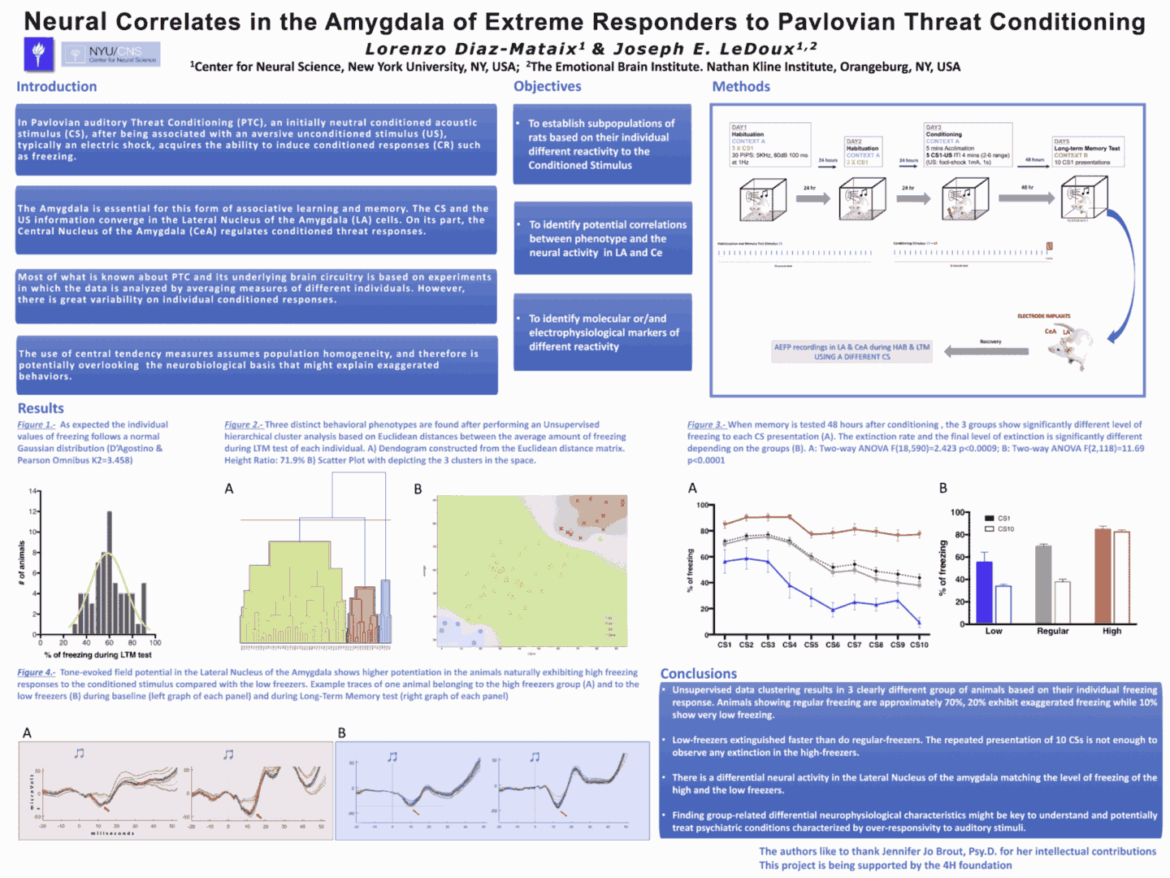
In this study Dr. Díaz-Mataix  separated out rodents by the level of their over-responsivity to repetitive stimuli. They rodents naturally fell into groups of extreme high responders, high responders, typical responders and low-responders. That means, that even in rodents there seems to be a range from extreme sensitivity to low sensitivity to repetitive auditory stimuli (just as there seems to be with people). People with misophonia would be like the extreme over-responder rodents.

Results show that extreme-responders are least likely to “un-learn” the association between  noxious stimuli and the physiological response (or fight/flight). However, this is a scientific experiment helps supports:

  • This the misophonia symptoms are truly due to physiological phenomena (i.e. if you can see it rodents who don’t “think” as we do, then we have more evidence that this is not a “psychological problem”
  • If “extreme-responders” are similar to those of us with  misophonia and are unable to “unlearn” an associated response between stimuli and an event ,than simple exposure therapy is highly unlikely to work
  • Given this information, memory reconsolidation, which is working for people with phobias in new trials, may be a promising remediation for misophonia symptoms

The illustration below is a poster from a neuroscience conference that demonstrates the first part of our study.  The IMRN hopes to continue  to support this work if more funding becomes available. We would very much like to see memory reconsolidation therapy for misophonia trialed.

[i] The physiologic response we often refer to as fight/flight follows a particular sequence that includes freezing (which comes first). However, we often freeze so quickly that it is unnoticeable to the human eye and/or we are not conscious of our self in this modality.

[ii] LeDoux (2015) Anxious: Using the Brain to Understand and Treat Fear and Anxiety. Penguin Random House. New York.


February 9, 2022 0 comments
0 FacebookTwitterPinterestEmail
pexels koolshooters 7346144
Coping

Misophonia Does Not Get Worse (or Better) Over Time

by Sensory Diversity November 3, 2021
written by Sensory Diversity

A lot of people I see (especially parents) worry that misophonia will get worse as a person ages. However, I want to come and tell you that there’s no evidence that this is true. In-fact, most people seem to stick with the same triggers they have (there’s about ten of them that are common: think whistling, chewing, coughing, snoring).

Misophonia, instead of getting better or worse over time, “waxes and wanes” (Dr. Jennifer Jo Brout). What this means is that there are times when a person is more troubled by sounds, whilst during others they can handle them more. If you’re stressed out during exams, a divorce, or any other life event, then it stands to reason that your neurosystem and fight-flight are going to be completely out of whack too. Similarily, during low-stress and happy times, misophonia can be on the backburner. For example, I remember misophonia being less of a concern whilst completely in bliss after my partner said “I love you” for the first time. It was an opportune moment to go to a movie theatre (and I think we actually did).

Similarly to this, avoidance is not going to make triggers better or worse. It’s completely okay to take your time and stay at home, or wear headphones. There’s no reason to believe with the current research that people are going to make misophonia worse by avoiding triggers.

I know that I can say if I take regular breaks and have boundaries that my over-all happiness level is much greater!

November 3, 2021 0 comments
0 FacebookTwitterPinterestEmail
heads hands violence neon light yellow blue orange t20 LOaNk1
AwarenessResearch

No, Misophonia is Not OCD, Stop Saying it Is

by Sensory Diversity September 24, 2021
written by Sensory Diversity

Misophonia is definitely not OCD. I say that, because I have both Misophonia and OCD, and yet some researchers are still conflating the two. I’m not entirely sure why researchers are so keen on misophonia being related with OCD. I’m not even sure why an OCD researcher would keep claiming this when the current science says misophonia has a motor basis. It’s really dangerous when researchers can keep getting published with their ideas, despite it being based on case-studies or studies that ignore the fact people with misophonia can’t stand exposure therapy.

In-fact, my OCD and misophonia are so completely different (albeit they do both cause torture).By the way, I work as an advocate for both Misophonia and OCD and am an active moderator of R/Misophonia and R/OCD on reddit.

I just want to point out from a purely emotional standpoint, that OCD and Misophonia are both misunderstood enough. We already struggle trying to get awareness, understanding, and empathy from the greater public. By conflating the two, it does a disservice to both disorders, and all of us who suffer with one or both of these disorders.

I’m concerned not just for misophonia sufferers, but because OCD sufferers also deserve researchers who are ethical and not clinging to ideas that seem to make absolutely no sense from a scientific standpoint. While OCD and Misophonia might be co-morbid, it is even painfully easy to see that they are different when living with the two disorders.

Now, I want to give you a laymen run-through of the differences between my OCD and my misophonia. While I am by no means an expert, I do have both, and I do advocate for both.

For example:

OCD Thought: Does my neighbor hate me? I smiled at her and she looked away. I bet she hates me.

Misophonia Thought: My neighbor mowed her lawn last week. Will she do it again? Will I be triggered?

Of course, this isn’t an exact science. Sometimes my OCD can take charge and ruminate over things related to misophonia, but they’re still not the same thing. OCD is a thought disorder. I panic because I can’t handle my thoughts. Aside from the misophonia, I really don’t have a thought relationship with lawnmowers, whistling, chewing, tapping. In-fact, before I had misophonia I almost never thought about this!

OCD plays on real (or imagined) fears. Misophonia, on the other hand, has to do with triggers that exist in the world. It has nothing to do with my thoughts. A trigger shows up, and somewhere deep in my non-cognitive brain, a threat is identified. The sound can be so low I barely hear it, and then whack there goes my fight flight. My palms sweat. My heart rate increases. I am in fight flight before I ever know what I’m thinking about. In OCD, the struggle comes from the thoughts I can’t get rid of. For example, my OCD loves to cling to whether or not my pets will die, whether family will die, or if my boyfriend will someday up and leave me. While people with misophonia do have cognitive fears, they are not the cause of the distress.

When I am upset by OCD, the thought repeats over and over in my mind. I will seek reassurance such as googling, “signs your boyfriend no longer loves you”, in the case of OCD, this makes things worse. Reassurance becomes a compulsion. In the case of misophonia, reassurance won’t do that, because the actual sound or visual is the trigger, and once that stops, you will calm down and go back to homeostasis. A good way to test this is by wearing a smart watch or fitness watch and noticing that the misophonic reaction goes down once out of the environment. OCD can feel like a reel that keeps repeating.

I’ll leave you with an excerpt from the Misophonia Literature Review:

In a recent replication and extension of Wu et al. (2014), Zhou et al. (2017) used the MQ to explore the relationship between misophonia and psychopathology in a sample of Chinese college students. Consistent with Wu et al. (2014), 17% of the sample (N = 415) reported misophonia symptoms caused clinically significant impairment in their daily lives. Higher MQ scores were significantly positively correlated with symptoms of anxiety, depression, and OCD. This suggests misophonia is not uniquely associated with anxiety, depression, or OCD per se, but may instead be more generally correlated with higher levels of psychological distress.

September 24, 2021 0 comments
0 FacebookTwitterPinterestEmail
pexels anna shvets 4226264
Research

Groundbreaking Research on the Motor Basis for Misophonia

by Sensory Diversity September 14, 2021
written by Sensory Diversity

An interview with Sukhbinder Kumar and Mercede Erfanian.

Would you describe the major findings of your study, “The motor basis for misophonia” (Journal of Neuroscience, 2021)

In our recent study, we have observed that in misophonia sufferers:

  • The pre-motor cortex that controls the movement of the throat, lips, and the face is involuntarily and automatically over-activated in response to trigger sounds (i.e., chewing, lip-smacking, etc.).
  • The pre-motor cortex and auditory cortex were hyperconnected which led to over-communication between these two brain substrates in response to all sounds.
  • The increased activation of the pre-motor cortex was attributed to emotional distress when confronted with the sound triggers.
  • There was an increased connection between the (ventral) pre-motor cortex and the insula (responsible for emotional processing, interoception, and saliency) at the resting state.
  • We found the same aberrant pattern (hyper-connectivity) between the pre-motor cortex and the visual cortex.

What does this mean?

Our findings suggest that the over-connection between the visual and auditory and pre-motor cortex activates the “mirror system” in the brain of the sufferers.

Would you describe what the mirror system is?

The mirror system is responsible for processing movements of other people in a similar fashion as if we make those movements. For example, people can spontaneously mimic the facial expression of others because of these sensory-motor or “mirror” neurons. Mirror neurons are theorized to influence learning and social behavior. Mirror neurons are the reason we may yawn when we see others yawn or smile if we see another person smile. Mirror neurons are also thought to underlie empathy.

How does this change the traditional view of misophonia?

We used to think that the neural underpinnings of misophonia were limited to auditory parts of the brain and the emotion-processing parts of the brain such as the insula (which is known to represent visceral signals from within the body such as the heart) and the amygdala (which mediates fight/flight response). However, these findings reveal that the route to emotional areas is also via the pre-motor/mirror system.

How does this explain misophonia reactivity?

We are not entirely sure. One hypothesis is that the involuntary activation of the mirror system results in the trigger stimuli being perceived as intruding into the sufferers’ personal space. This may set off the nervous system reactivity. However, more research needs to be done in order to answer this question.

How does misokinesia fit in there? Is it possible that based on the original definition of misokinesia (hatred of movement) that gross motor areas of the brain are also involved? For example, many people describe great aversion when they see someone shaking their leg.

Our work so far has concerned only typical triggers in misophonia. But the model we proposed, in principle, can be extended to explain misokinesia. That is if somebody finds “shaking leg” as triggers, it is likely that it involves hyperactivation of the “leg” motor area in the brain. This needs to be confirmed by further empirical research. Further empirical validation needs further research.

What does this imply in terms of potential therapy?

One important consequence for the potential therapy is that “sounds” in misophonia are not the whole story. In our model, they are only a “medium” via which the action of the trigger person is “mirrored.” The effective therapy, therefore, would, not only concern the auditory part of the brain but also involve the motor part of the brain. More concretely, the therapy should aim to weaken the link between sound and the action which is overly represented in misophonia. Of course, further research is needed to help us define potential therapies.

Would this explain why exposure therapy, for example, has not been successful?

According to these findings, it is possible that the exposure therapy is not efficacious but may also lead to sustained over-activations of the aforementioned brain areas (consequently reinforcing the aberrant functional connections between them).

What are your next steps for research?

I [SK] aim to carry forward the current work in two streams. First, I would like to explore using cost-effective brain measurements such as EEG to show the involvement of “mirror” system in misophonia. Second, I would like to explore the use of non-invasive brain stimulation such as TMS (transcranial magnetic stimulation) to temporarily interrupt the “mirror” system to show its “causal” role in misophonia, in collaboration with other TMS researchers. In addition, I [ME] would like to explore how and why triggers expand into non-orofacial related sounds with specific acoustic parameters (i.e., pattern-based and repetitive).

Thank you both (and thank you to everyone who assisted with this paper) so very much for this interview and for this incredible contribution to misophonia research!


Originally posted on Psychology Today.


References

The motor basis for misophonia
Sukhbinder Kumar, Pradeep Dheerendra, Mercede Erfanian, Ester Benzaquén, William Sedley, Phillip E. Gander, Meher Lad, Doris E. Bamiou, Timothy D. Griffiths
Journal of Neuroscience 21 May 2021, JN-RM-0261-21; DOI: 10.1523/JNEUROSCI.0261-21.2021

September 14, 2021 0 comments
0 FacebookTwitterPinterestEmail
lefty left handed handy woman t20 aa0pd9
Research

Not All Research is Good (Or Even Ethical) Research

by Sensory Diversity August 27, 2021
written by Sensory Diversity

Since misophonia is a newer disorder, and one in which the consensus is still being reached, there is a lot of room for “researchers” to get things wrong. In-fact, getting things wrong is often and important part of the scientific approach. This is why replication is one of the most important things in studies—if something cannot be replicated, it is not yet seen as truth. And yet, despite this, charlatans are often quick to tote “studies” (often one time case studies without replication) as “proof” that their treatment or theory is legitimate. This is dangerous.

I want to first point out that technically speaking, anybody can be published as a researcher. Traditional barriers of entry like having a Research Centre or University backing are becoming less and less with the birth of entirely online journals. More chilling, there is a growing number pay to play publications that essentially take the money of the author—go through an expedited “peer review” process—and then churn out whatever “research” was submitted under the guise of science. There is no money in rejecting numerous papers. This is why people who are not PhDs, or even in strict research fields can get in so many journals. Whether a person is a behavioral analyst, doctor, or a janitor, their “research” can join the world with little to no barriers. Except a little money.

To further this unethical practice, the internet has little to no rules for claims and name ownership. One can be an “institute” or “centre” without ever having a physical address or license to back this claim. After-all, anybody can buy a domain name with a tricky keyword and try to tell the world they’re an expert. This is a frustrating reality, but, one we have to live with and learn to parse out and avoid for ourselves.

Even more insidious than pay to play researchers are doctorate level researchers without sufficient neuroscience background insisting that misophonia is cognitive. This is particularly pervasive with CBT research, despite little to no replicable evidence that exposure or CBT is helpful for misophonia. In fact, most people who tried exposure, have come back with saying it was a “torturous” experience. With that said, these cognitive researchers are so shut off and set in their ways that they refuse to acknowledge research from neuroscientists like Sukhbinder Kumar which show an entirely different picture of misophonia—and one that has been shown on brain scans, not just with case studies and theories.

To a hammer everything looks like a nail.”

It is very unfortunate that even at the doctorate level (PhD) we have researchers who are blind to emerging studies and toting their own irresponsible theories as scientific evidence. Even more insidious, these researchers have easier access to publication, and are well-respected by their peers. I am horrified by the possibility that cognitive behavioral therapy (CBT) will become the go-to to worldwide therapists merely because of half-baked research that presents misophonia as receptive to exposure—despite the little evidence that it’s even cognitive instead of neurological.

This is flabbergasting to me. I was always taught that science is the pursuit of following the evidence, but instead, many camps of theories are emerging that are blatantly ignoring the reality, data, and brain scans of people who actually have misophonia and were studied.

Parents and sufferers must be proactive about misophonia advocacy. Share studies with your therapists and let them know of the emerging neuroscience. You can always find research at www.misophonia-research.com and send this link to clinicians, colleagues, and peers. It is an unfortunate reality that we must be vigilant when we read “scientific” studies, but like science itself, questioning everything and seeing if there are replicated results (multiple sources) is the only way forward.

If you have tried a “treatment” that did not help, please share your story to help others avoid the same experience!

August 27, 2021 0 comments
1 FacebookTwitterPinterestEmail
pexels lola russian 1804514
Coping

Misophonia is Not a Life Sentence

by Sensory Diversity August 8, 2021
written by Sensory Diversity

When I first wrote Full of Sound and Fury I used the very words of this article in the book. I said that, “Misophonia is not a life sentence” and I will admit that I was a bit skeptical. I wanted to hope those words into existence and believe that misophonia wasn’t going to take everything away from me. And, in fact, it didn’t.

It can be very easy to worry about our futures (or the future of your child or loved one with misophonia) but like other disabilities or neurological conditions, life is still meaningful for sufferers of misophonia. Once a balance has been achieved, life goes on and while it might not be easy, we all have our challenges to be met.

I have a loving partner who supports me and accommodates my misophonia. When I go out in public I have ear plugs and my Bose headphones to ensure that I’m able to block noises if necessary. I will admit the visual triggers are harder to avoid, but with my stress levels lower (I’ve been treated for OCD, Depression, Anxiety), I am able to manage these symptoms. It was important for me to recognize symptoms that were not misophonia and get treatment for what I could. Lowering stress and over-all threat-levels is very important for long term management of misophonia.

Dr. Brout’s manual Regulate Reason Reassure is a great starting point for parents or clinicians who are interested in misophonia coping skills. Accepting misophonia can be hard, but it’s an important part of moving forward and conquering misophonia as best we can before there is an available treatment.

While I feel I’m ranting slightly, my point is that with life adjustments (it’s okay to skip restaurant meals and not go to events that are super busy), we are able to enjoy our lives and have meaningful and engaging moments.

For example, I work from home so that I am able to better control my environment. While I know this isn’t possible for everyone, it can be very helpful in the long term to be able to avoid the hustle and bustle of the day. I know that I personally cannot work in an office, and I wouldn’t be able to survive very long on a 9-5 lifestyle.

As I learn my boundaries and come up with solutions (sleeping in separate beds, having headphones, listening to music at dinner), I become more adapted to my environment and then can cope easier with other scenarios because I’m not as on edge all the time.

As somebody who has struggled with Misophonia for years, I can honestly say that it’s not a life sentence, but a life adjustment.

August 8, 2021 0 comments
0 FacebookTwitterPinterestEmail
Newer Posts
Older Posts

Sensory Diversity is the recognition that every individual perceives, filters, and responds to the world in a unique way. While neurodiversity celebrates the different ways we think, sensory diversity focuses on the gateway to those thoughts: our senses.

Social media infographics and posts are not a reflection of the views of the site owner or individual site authors. These posts come from a variety of sources and reflect numerous viewpoints through the sensory and neurodiversity community.

Recent Posts

  • Sensory Accessibility Suggestions for World of Warcraft
  • When It Isn’t ADHD or Autism: The Lost Tribe of Neurodivergence
  • What It’s Like Living With Misophonia
  • How Misophonia Actually Feels for Sufferers
  • What is Sensory Dysregulation?

Recent Comments

  1. Lilian on Misokinesia
  2. admin on Misokinesia
  3. Dense Caldwell on Misokinesia

Product links may be affiliate links. This site makes a small commission off these links.

  • Facebook
  • Instagram
  • Linkedin
  • Tumblr

@2021 - All Right Reserved. Designed and Developed by PenciDesign


Back To Top
Sensory Diversity
  • Home
  • Blog
  • Neurodivergence
    • What is Autism?
    • What is ADHD?
    • What is Sensory Integration / Sensory Processing Disorder?
    • What is Misophonia?
    • What is Misokinesia?
  • Sensory Lifestyle
  • Sensory DIY

Shopping Cart

Close

No products in the cart.

Close