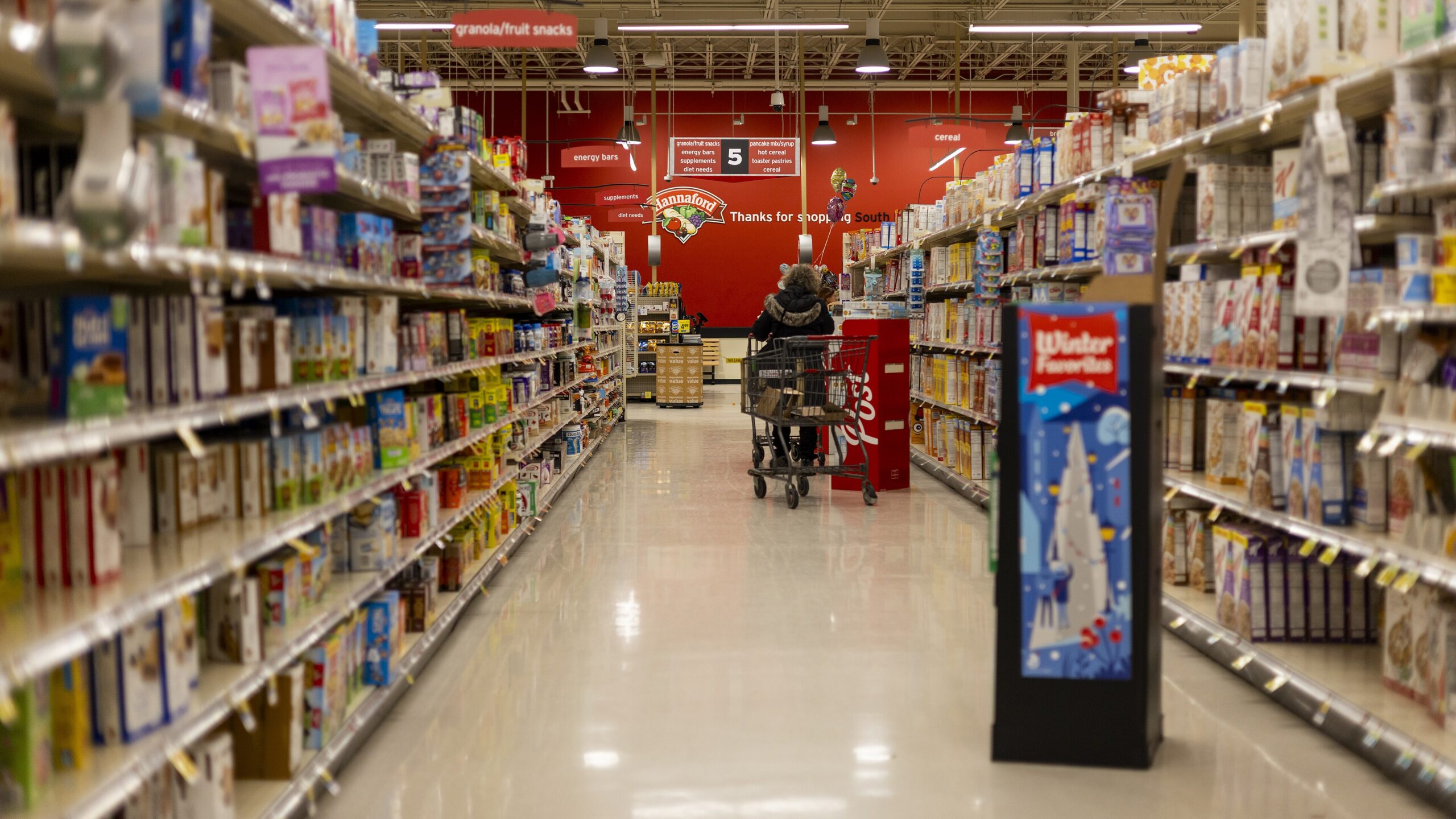
A supermarket asks a shopper to do far more than choose food. Fluorescent or LED lighting fills a large room with few visual breaks. Refrigeration units hum continuously. Carts rattle, scanners beep, public-address announcements interrupt, people change direction without warning, and shelves compete for attention with hundreds of colors, labels, prices, signs, and promotional displays. At the same time, the shopper has to remember a list, compare products, make decisions, navigate other people, monitor time, and eventually tolerate a checkout line. For some autistic and otherwise sensory-sensitive people, the difficulty of grocery shopping comes from that combination rather than from any single sound or light.
Supermarkets Concentrate Several Demands at Once
Research on autistic adults supports the idea that the supermarket itself can function as a disabling environment. A participatory study of 24 autistic adults across seven focus groups identified supermarkets as the public setting most often described as disabling in relation to sensory input. The researchers did not reduce the problem to noise alone. Their analysis emphasized an interacting set of factors including the overall sensory environment, available space, predictability, whether other people understood sensory needs, what adjustments were possible, and whether there was an opportunity to recover afterward. Because the study was qualitative and relatively small, it cannot establish how every autistic person experiences supermarkets, but it provides detailed evidence that accessibility depends on the relationship between the person and the setting.
The cognitive demands of shopping can compound that sensory load. Finding an item may require scanning a visually dense shelf while remembering the intended product, comparing prices or ingredients, and ignoring competing displays. A changed store layout, an unexpectedly unavailable product, or a crowded aisle can add more decisions. The Sensory Diversity manuscript discusses grocery shopping among everyday activities that can become harder when executive-function and sensory demands accumulate. That framing is useful because a person can understand perfectly well how grocery shopping works and still find the environment unusually costly to navigate.
Sound Can Change the Shopping Experience
An experimental supermarket study examined this more directly. Thirty-eight autistic and 37 neurotypical adults completed a video-based shopping task under three auditory conditions: no added sounds, non-social supermarket sounds such as refrigerator noise, and social sounds such as people talking. Autistic participants described both sound conditions as more difficult than the no-sound condition, and they rated the social-sound condition more negatively than neurotypical participants. The study does not recreate every feature of a real supermarket, but it demonstrates that ordinary ambient sound can alter the experience of making shopping decisions.
That also explains why personal ear protection may help without solving the entire problem. Headphones or earplugs can reduce some sound, but they may make speech, announcements, or checkout interactions harder to hear. They do not remove glare, visual clutter, crowd movement, smells, narrow aisles, or the need to make decisions. Some people also dislike the pressure or occlusion created by ear protection. An accessibility plan that assumes every sensory-sensitive shopper can simply wear headphones transfers responsibility for the whole environment back onto the individual.
What Quiet Hours Actually Change
Retail quiet hours attempt to alter the environment itself. Current Coles Quiet Hour information describes a low-sensory shopping period in which participating supermarkets reduce sound and, depending on the store, lighting. Walmart has likewise maintained sensory-friendly hours in U.S. and Puerto Rico stores, using measures such as turning off the radio, showing static images on television walls, and lowering lights where possible. These are relatively modest operational changes, but they target sources of stimulation that shoppers cannot control themselves.
The accessibility value is not that silence is inherently better for autistic people. Some people actively seek music, movement, bright environments, or social activity. Others may find an unusually quiet store uncomfortable or may rely on auditory cues that become less noticeable when the environment changes. The stronger principle is adjustability: quiet-hour programs create at least one predictable period in which some sensory demands are deliberately reduced, giving shoppers another option rather than defining one environment as universally correct.
Quiet Hours Do Not Make Every Barrier Disappear
A scheduled low-sensory period has important limitations. Refrigeration systems still run. Products remain visually dense. Other customers may still talk, children may cry, carts may collide, and emergency announcements remain necessary. Stocking, cleaning, alarms, unexpected crowds, or maintenance equipment can introduce noise even during a designated quiet period. A person who works, attends school, depends on transportation, or needs groceries at a different time may not be able to use the program at all.
There is also a difference between reducing stimulation and improving predictability. A shopper may benefit from an accurate store map, consistent aisle organization, clear signage, accessible online inventory information, advance notice of construction or layout changes, and straightforward information about exactly what a quiet hour does and does not modify. Someone who becomes overwhelmed partway through a trip may need a place to pause, a faster checkout option, or the ability to leave and complete the order another way. Sensory-friendly retail therefore extends beyond turning down music for sixty minutes.
Design for Choice Rather Than a Single Sensory Profile
A more accessible supermarket gives shoppers multiple ways to reduce demand. That can include quieter periods, predictable layouts, less intrusive audio advertising, controlled screen movement, clear signs, pickup or delivery options, staff who understand invisible accessibility needs, and policies that permit personal sensory tools. None of those adjustments guarantees that every shopper will find the store comfortable, and different needs can conflict. Lower lighting may help one person while making labels harder for someone with low vision, for example, which is why adjustable and optional approaches are usually stronger than one-size-fits-all rules.
Quiet hours are useful precisely because they change part of the environment instead of asking every overwhelmed shopper to become better at enduring it. Their limitation is that sensory accessibility cannot be compressed into one hour or one intervention. Supermarkets are complex environments, and the people using them have different sensory profiles, schedules, support needs, and goals. The more useful question is not whether a store has earned the label “sensory friendly,” but whether shoppers have meaningful choices that make an essential daily activity more usable.