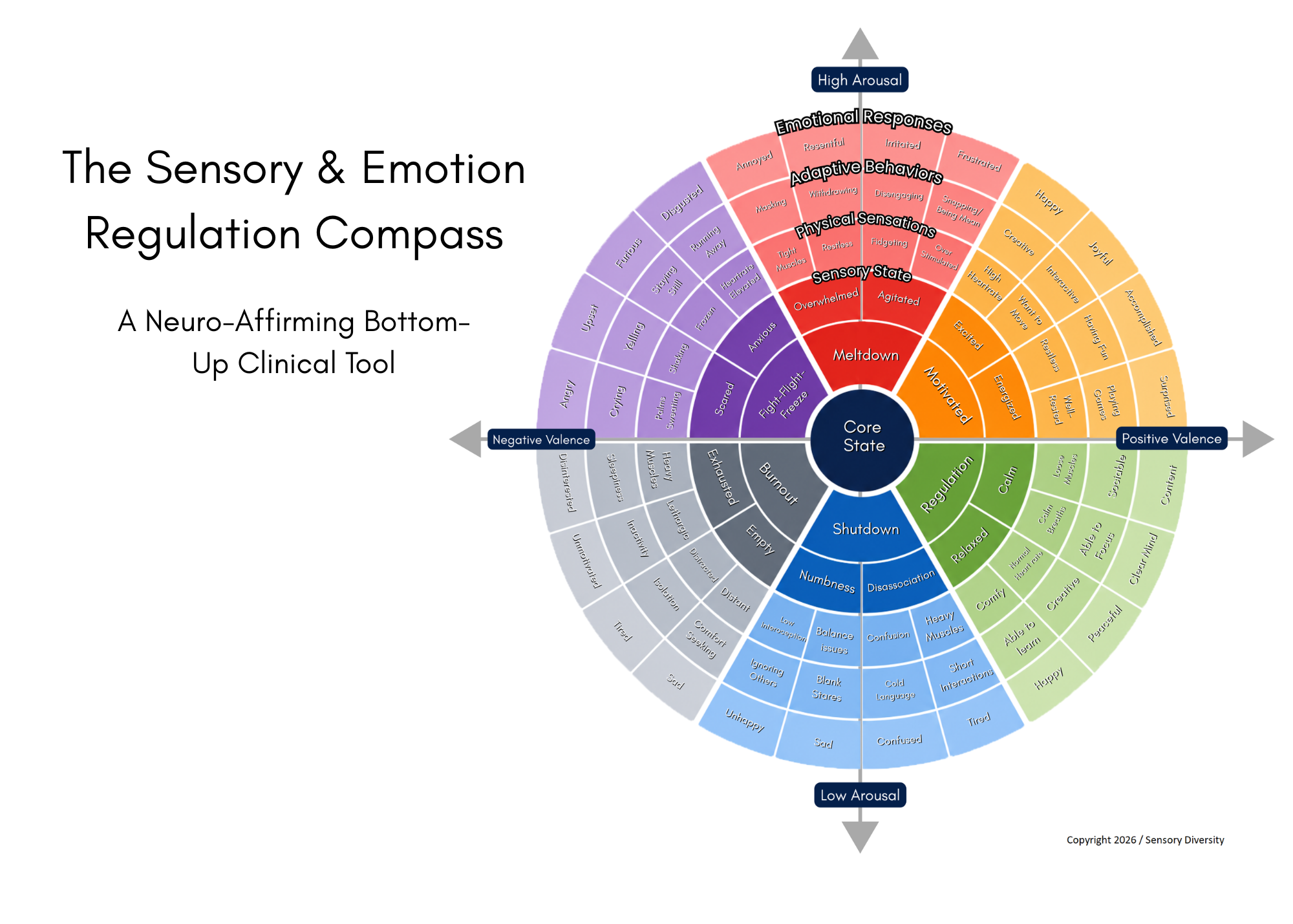
The Sensory & Emotion Regulation Compass was developed as a neuro-affirming clinical tool designed to help individuals better identify and understand the complex relationship between sensory experiences, nervous system states, adaptive behaviors, physical sensations, and emotional responses.
Unlike many traditional emotion wheels that begin with emotional labeling alone, the Compass uses a bottom-up approach. Rather than assuming that individuals first identify emotions cognitively, the tool recognizes that many people—particularly neurodivergent individuals—often experience body sensations, sensory shifts, urges, behaviors, or changes in energy before consciously identifying an emotional state.
For many individuals, internal experiences may first present as:
- tension,
- fatigue,
- restlessness,
- overstimulation,
- withdrawal,
- numbness,
- movement-seeking,
- shutdown,
- or overwhelm
before these experiences are understood emotionally.
The Compass was created to support awareness of these interconnected internal experiences in a way that is flexible, non-pathologizing, and grounded in sensory and emotional regulation principles.
A Bottom-Up Perspective
The Compass is informed by concepts found across sensory regulation science, emotion regulation research, interoception, somatic awareness, neurodivergent lived experience, and nervous system regulation models. However, the tool intentionally uses broad, accessible language rather than relying on one specific therapeutic or theoretical model.
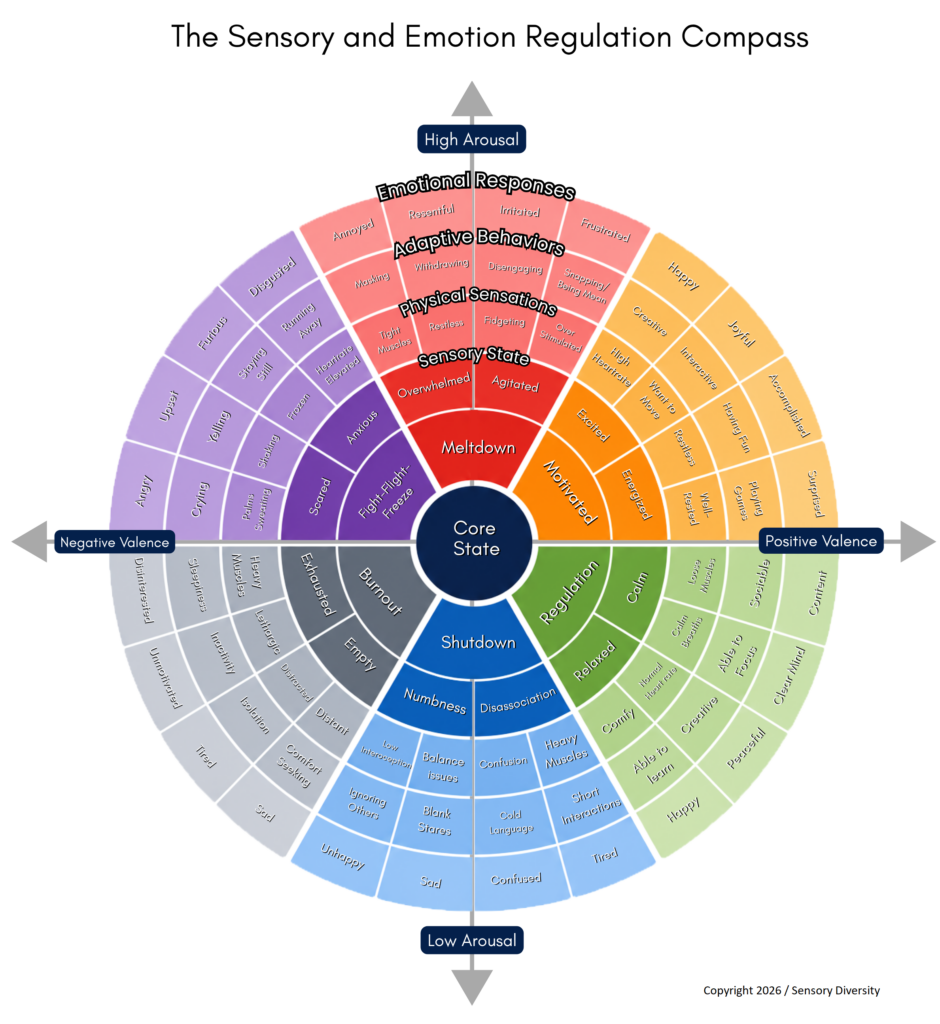
The wheel organizes experiences into layered rings that move outward from core nervous system states into increasingly interpreted and observable experiences.
The rings include:
- Core State
- Sensory State
- Physical Sensations
- Adaptive Behaviors
- Emotional Responses
This structure reflects the understanding that emotional experiences are often embodied, sensory, behavioral, and relational rather than purely cognitive.
Understanding the Core States
The center of the Compass is organized around broad internal states such as:
- Regulation,
- Motivation,
- Fight-Flight-Freeze,
- Meltdown,
- Shutdown,
- and Burnout.
These states are not intended to represent fixed categories or diagnoses. Instead, they reflect broad patterns of nervous system activation, recovery, engagement, overload, and depletion.
The Compass also recognizes that states frequently overlap. A person may simultaneously experience elements of:
- regulation and burnout,
- motivation and overwhelm,
- shutdown and anxiety,
- or sensory overload and social engagement.
Human experiences are dynamic and fluid. Individuals often move between states throughout the day depending on sensory input, environmental demands, social interactions, stress levels, energy availability, and recovery opportunities.
Sensory States and Physical Sensations
Many individuals, particularly those with sensory processing differences or alexithymia, may notice body sensations before identifying emotions.
For example, a person may first recognize:
- tight muscles,
- buzzing,
- exhaustion,
- shallow breathing,
- nausea,
- numbness,
- increased movement,
- or sensory discomfort
before recognizing emotional responses such as anxiety, frustration, excitement, sadness, or overwhelm.
The Compass therefore prioritizes sensory and physical experiences as important components of emotional awareness rather than treating emotions as isolated mental states.
Adaptive Behaviors
The Adaptive Behaviors ring reflects ways individuals respond to, cope with, regulate, or interact with their nervous system state.
These behaviors may include:
- masking,
- withdrawing,
- fidgeting,
- movement-seeking,
- avoiding stimulation,
- shutting down,
- seeking comfort,
- social engagement,
- hyperfocus,
- or disengagement.
Importantly, adaptive behaviors are not framed as inherently “good” or “bad.” Rather, they are understood as responses that often develop in the context of sensory, emotional, environmental, or nervous system demands.
This neuro-affirming perspective allows behaviors to be explored with curiosity and compassion rather than judgment.
Emotional Responses
The outer ring of the Compass includes emotional experiences and interpretations that may emerge from the interaction between sensory experiences, physical sensations, behaviors, context, and nervous system states.
The tool acknowledges that emotional experiences are often overlapping, blended, and contextual rather than fixed or singular. Individuals may identify with multiple emotional responses simultaneously or experience the same physical sensation differently depending on the surrounding context and state.
The Compass Structure
The Compass also incorporates a subtle directional structure inspired by emotional regulation and sensory regulation research.
Broadly, the wheel reflects movement between:
- higher and lower activation states,
- approach and withdrawal tendencies,
- engagement and depletion,
- and pleasant and unpleasant experiences.
However, the Compass is not intended to rigidly categorize experiences into “positive” or “negative” states. Instead, it serves as a navigational map of internal experiences and nervous system movement.
The compass framing reflects the understanding that individuals are constantly navigating changing internal and external conditions rather than existing in fixed emotional categories.
Burnout and Shutdown
One of the core distinctions within the Compass is the separation between shutdown and burnout states.
While these experiences may overlap, they are not identical.
Shutdown may occur more acutely in response to overload, stress, exhaustion, sensory input, or nervous system overwhelm. Burnout, on the other hand, often reflects longer-term depletion associated with chronic stress, masking, overload, reduced recovery, and prolonged activation.
The Compass acknowledges that burnout and shutdown states may persist longer than other states, particularly when opportunities for regulation, recovery, support, or sensory safety are limited.
How to Use the Compass
The Sensory & Emotion Regulation Compass is not intended to be used in a rigid or linear way.
Individuals do not need to:
- start from the center,
- choose only one category,
- or identify with only one state at a time.
Instead, users may explore the wheel by noticing:
- body sensations,
- sensory experiences,
- behaviors,
- emotional responses,
- or broader nervous system patterns.
Some individuals may begin with emotions, while others may begin with physical sensations or adaptive behaviors. The tool is designed to support flexible exploration rather than strict categorization.
The Compass may be used:
- individually,
- therapeutically,
- educationally,
- in advocacy work,
- in support groups,
- in occupational therapy,
- in psychoeducation,
- or as part of self-reflection and regulation practices.
Copyright and Usage
The Sensory & Emotion Regulation Compass is an original copyrighted clinical tool and psychoeducational resource created by Shaylynn Hayes-Raymond.
The image and tool may not be reproduced in books, manuals, trainings, commercial publications, edited derivatives, or redistributed altered versions without permission.
However, clinicians, educators, advocates, support workers, and community organizations are welcome to use the unedited image freely within:
- clinical practices,
- advocacy work,
- psychoeducation,
- presentations,
- support settings,
- and non-commercial educational environments,
provided the original work remains unaltered and proper credit is maintained.
Conclusion
The Sensory & Emotion Regulation Compass was created to offer a more integrated, neuro-affirming way of understanding internal experiences. By combining sensory awareness, nervous system states, adaptive behaviors, physical sensations, and emotional responses into one navigational clinical tool, the Compass encourages individuals to approach regulation with greater self-awareness, flexibility, and compassion.
At its core, the tool recognizes that human experiences are complex, overlapping, embodied, and constantly shifting. Rather than forcing experiences into rigid categories, the Compass invites individuals to explore their internal world with curiosity, understanding, and respect for the ways nervous systems adapt and respond to the world around them.