
Finding accurate information about video game accessibility can be difficult. Details are often scattered across official game websites, support pages, patch notes, reviews, community forums, and modding platforms. A player may need to search several different sources just to learn whether a game includes customizable subtitles, remappable controls, reduced camera movement, visual adjustments, or other features that affect whether the game is comfortable and playable.
GamingAccessibility.org was created to bring that information together in one searchable plac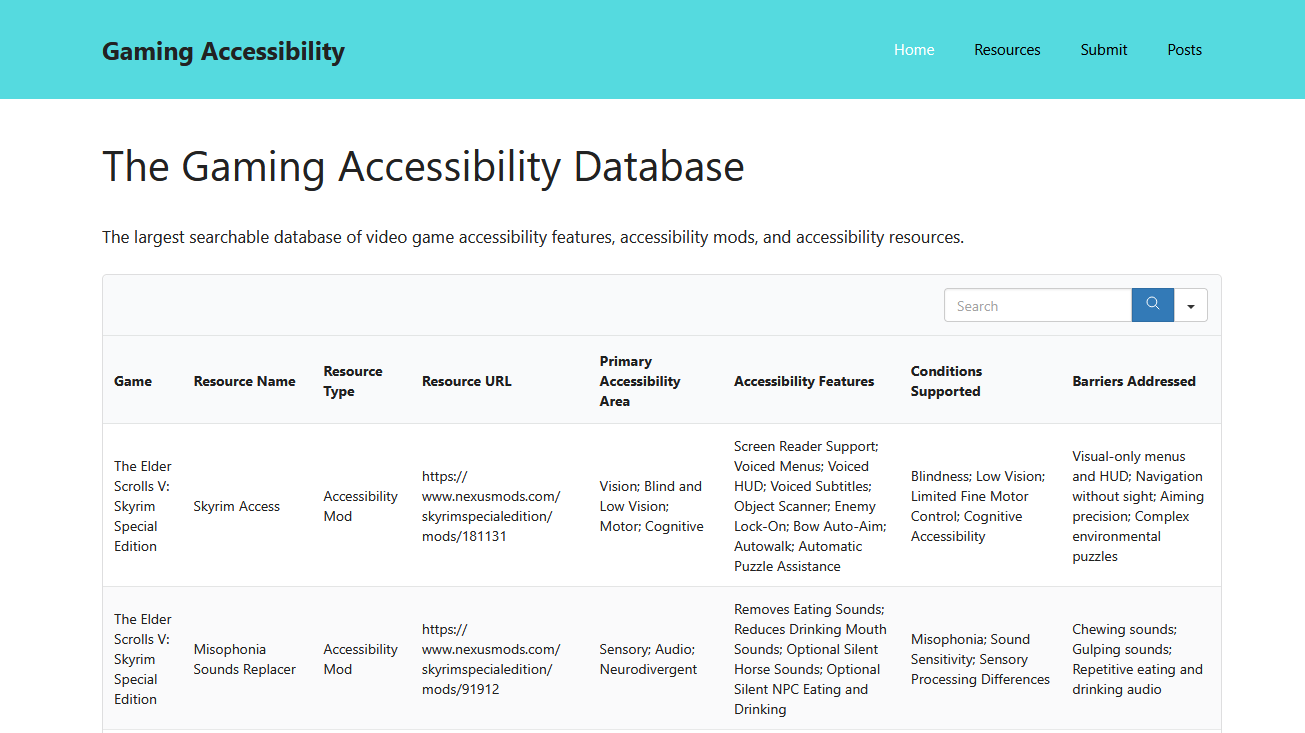
The project’s goal is to build a large, practical database of accessibility features and accessibility-related modifications for video games. Instead of focusing on reviews, ratings, or advocacy campaigns, the website is designed as a neutral reference tool. Visitors will be able to search for a game and see which accessibility options are available, or search for a particular feature and discover games that may meet their needs.
The database includes both features built directly into games and modifications created by the gaming community. Built-in accessibility options may include subtitle customization, control remapping, difficulty settings, camera adjustments, visual filters, audio controls, navigation support, interface customization, and other settings that can make a game easier to use. Each feature is recorded separately so that users can search for the specific options that matter to them instead of relying on a general accessibility label.
Community-created mods are also an important part of the project. Some games have limited accessibility settings when they are released, but players and mod developers may create solutions that improve readability, reduce uncomfortable effects, simplify controls, change interfaces, adjust audio, or make other useful changes. These resources are clearly identified as mods or add-ons so users can distinguish them from official features included by the developer.
This combination makes GamingAccessibility.org different from many existing gaming resources. Official accessibility pages are useful, but they usually cover only one game, one publisher, or one platform. Reviews can provide valuable personal experiences, but they may not include every setting or remain current after updates. Modding websites contain thousands of useful files, but accessibility-related mods can be difficult to locate because they are spread across many categories and may not use consistent terminology.
GamingAccessibility.org is intended to act as a central index connecting these sources. Whenever possible, database records include links to official accessibility information, developer support pages, legitimate modding platforms, or other relevant sources. This allows users to review the original information and learn more about a feature before purchasing, installing, or playing a game.
The project is being built as a structured database rather than a collection of general articles. Every accessibility feature is stored as an individual record with consistent fields. These records can include the game title, platform, accessibility category, feature name, description, source, resource link, and whether the feature is built in or provided through a mod. Organizing the information this way makes it possible to filter and search a very large number of entries.
The public database will be presented through GamingAccessibility.org using a searchable table system. The underlying information is maintained in a master CSV file, which allows records to be researched, reviewed, corrected, expanded, and imported into the website in a consistent format. This approach also makes the project easier to maintain as new games are released and existing games receive updates.
The database is intended for a wide audience. Players can use it to research games before buying them or to discover settings they may have overlooked. Families and caregivers can use it to compare games. Developers and mod creators can use it to see how other games approach accessibility. Writers, educators, researchers, and accessibility professionals may also find the structured information useful when studying patterns across the gaming industry.
GamingAccessibility.org does not assume that every player has the same needs or that one feature makes a game universally accessible. Accessibility is highly individual. A setting that is essential for one person may be unnecessary for another, while some players may need several features to work together. For that reason, the database focuses on describing what is available rather than declaring that a game is simply accessible or inaccessible.
Accuracy and transparency are central to the project. Information will be based on available documentation and clearly linked sources whenever possible. Because games change over time, the database will also need ongoing updates. Developers add new settings, patches alter existing features, mods are released or removed, and new accessibility information becomes available. The project is therefore designed to grow continuously rather than function as a finished, static list.
The long-term vision is to make GamingAccessibility.org one of the most comprehensive searchable references for video game accessibility. As the database expands, it will cover more games, more platforms, more built-in features, and more community modifications. The aim is not to replace the work of accessibility organizations, reviewers, developers, or modding communities, but to make their information easier to find and use.
GamingAccessibility.org is built around a straightforward idea: players should not have to search the entire internet to determine whether a game includes the options they need. By gathering accessibility information into a clear, searchable database, the project will help people make more informed choices and find more ways to play.